
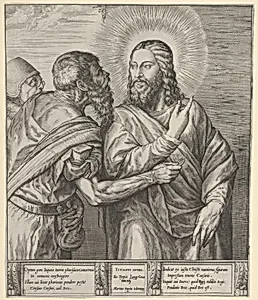
The Tribute Money: two Pharisees, one holding out a coin in his right hand, approach Christ from the left
after ca. 1560–68
Medium
Engraving
Dimensions
sheet: 10 15/16 x 9 1/4 in. (27.8 x 23.5 cm)
Classification
Prints
Department
Drawings and Prints
Museum
Metropolitan Museum of Art, New York, NY
Credit
Bequest of Phyllis Massar, 2011
Accession Number
2012.136.303
Rights
Public Domain
Tags
Art Historical Context
Behold *The Tribute Money*, a captivating engraving from after ca. 1560–68, now housed in the Metropolitan Museum of Art's Drawings and Prints department. This print, measuring 10 15/16 x 9 1/4 inches, features a pivotal biblical moment: two Pharisees approach Christ from the, one extending a coin in his right hand. Attributed to Martino Rota Titian (Tiziano Vecellio), and Luca Guarinoni, it likely reproduces a composition by the Venetian Renaissance master Titian, with Rota or Guarinoni translating his design into intricate engraving lines. The scene draws from Matthew 22:15–22 in the New Testament, where Pharisees challenge Jesus on paying tribute to Caesar, prompting his famous reply: "Render therefore unto Caesar the things which are Caesar's." Titian's involvement underscores its artistic prestige; as a leading figure in the Venetian school, he blended dramatic composition with humanism, themes echoed here through the tense confrontation and symbolic coin—representing faith versus worldly authority. Engravings like this were revolutionary in the 16th century, enabling Titian's grand visions to reach collectors and scholars across Europe beyond paintings alone. The meticulous technique—incising details into a metal plate for rich, tonal prints—captures the figures' expressive gestures and folds of drapery, making profound religious narratives accessible and intimate for Renaissance audiences. A generous bequest from Phyllis Massar in 2011 brings this gem to life today.