
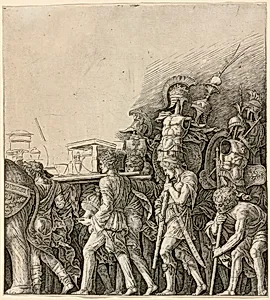
The Triumph of Caesar: Soldiers Carrying Trophies
c. 1497/1498
Medium
engraving on laid paper
Dimensions
sheet: 28.2 x 26 cm (11 1/8 x 10 1/4 in.)
Classification
Department
CG-E
Museum
National Gallery of Art, Washington, D.C.
Credit
Rosenwald Collection
Accession Number
1943.3.5771
Rights
Public Domain
Art Historical Context
Created around 1497–1498 in the workshop of Andrea Mantegna, *The Triumph of Caesar: Soldiers Carrying Trophies* captures a vivid moment from a celebrated Renaissance series depicting Julius Caesar’s victorious return to Rome. Mantegna, renowned for his deep fascination with classical antiquity, drew inspiration from ancient Roman reliefs and literary accounts to reconstruct the grandeur of a triumphal procession. This engraving, produced after the artist’s monumental paintings for the Gonzaga court in Mantua, allowed viewers across Europe to experience the spectacle through the newly powerful medium of print. Rendered as an engraving on laid paper, the work showcases the precise line work and rhythmic composition characteristic of Mantegna’s workshop. The soldiers stride forward with captured arms, standards, and spoils, their muscular forms and carefully observed armor reflecting the Renaissance revival of classical ideals. Measuring just over 11 by 10 inches, the intimate scale invites close examination of every detail, from the texture of fabric to the weight of bronze trophies. As part of the Rosenwald Collection at the National Gallery of Art, this print highlights how Mantegna’s imagery helped shape a shared visual language of antiquity that influenced generations of artists and collectors. It stands as both a historical document of Roman ceremony and a testament to the enduring appeal of classical themes during the Renaissance.