
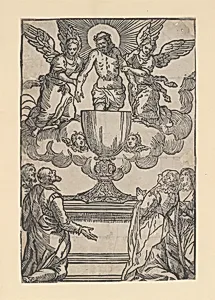
The Triumph of the Eucharist, Christ as the Man of Sorrows supported by two angels standing in a chalice
ca. 1550–1600
Medium
Woodcut
Dimensions
Sheet: 10 1/2 × 6 15/16 in. (26.6 × 17.7 cm)
Classification
Prints
Department
Drawings and Prints
Museum
Metropolitan Museum of Art, New York, NY
Credit
Rogers Fund, 1922
Accession Number
22.73.3-120
Rights
Public Domain
Tags
Art Historical Context
In the heart of this striking 16th-century Italian woodcut, *The Triumph of the Eucharist Christ appears as the Man of Sor—a poignant iconographic tradition depicting him wounded and mournful after the Crucifixion. Here, he is tenderly supported by two angels within a grand chalice, symbolizing Eucharistic vessel where bread and wine transform into Christ's body and blood. This anonymous print, created around 1550–1600, masterfully blends sorrow with triumph, elevating suffering to divine victory. Produced during the Counter-Reformation, when the Catholic Church reaffirmed core doctrines like the Eucharist against Protestant critiques, the artwork served as devotional propaganda. Woodcuts like this were ideal for widespread dissemination: carved in relief on wooden blocks, they allowed inexpensive printing on paper, making sacred imagery accessible to pilgrims, clergy, and the faithful beyond elite patrons. Measuring just 10½ × 6⅞ inches, this intimate yet powerful sheet from the Metropolitan Museum of Art's collection highlights the era's blend of emotional piety and technical innovation. Gaze upon it, and feel the era's fervent faith come alive in every carved line.