
The Two Are But One (Les deux ne font qu'un)
late 18th century
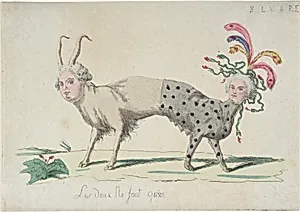
Medium
Hand-colored etching
Dimensions
sheet: 5 7/8 x 8 3/8 in. (15 x 21.3 cm)
Classification
Prints
Department
Drawings and Prints
Museum
Metropolitan Museum of Art, New York, NY
Credit
The Elisha Whittelsey Collection, The Elisha Whittelsey Fund, 1962
Accession Number
62.520.106
Rights
Public Domain
Tags
Art Historical Context
Welcome to the Metropolitan Museum of Art's Drawings and Prints department, where you'll find *The Two Are But OneLes deux ne font qu)*, a hand-colored etching by an anonymous French artist from the late 18 century. Measuring just 5 7/8 x 8 3/8 inches, this compact print was designed for wide circulation, reflecting the era's booming market for affordable graphic satire. Acquired through The Elisha Whittelsey Collection in1962, it captures the sharp wit of French printmaking during a time of social upheaval. Created amid the Enlightenment and the eve of the French Revolution, this satirical work exemplifies how etchings—known for their precise lines and tonal depth—served as powerful tools for commentary. The hand-coloring, applied by skilled artisans after printing, adds vividness and irony, making complex political or social jabs accessible to everyday viewers. The title, suggesting an unlikely unity ("the two are but one"), hints at mocking perceived hypocrisies or alliances, a staple of the period's subversive pamphlets and broadsheets. These prints were the social media of their day, fueling public discourse and challenging authority. Today, *The Two Are But One* reminds us of satire's enduring role in democracy, preserved as a testament to anonymous voices shaping history.
About the Artist
Anonymous, French, 18th century · 1700–1800
The artist known as Anonymous, French, 18th century, represents a collective of unidentified talents active roughly between 1700 and 1800, a period of profound artistic evolution in France from the opulent Rococo to the austere dawn of Neoclassicism and Revolutionary fervor. Little is documented about their personal training or mentors, as their anonymity obscures individual biographies, though th...