
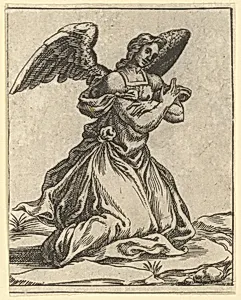
The Virgin of Sorrows: Angel; one of nine surrounding compartments from the Virgin of Sorrows, now separated
by 1575
Medium
Engraving
Dimensions
Sheet: 2 13/16 × 2 1/4 in. (7.2 × 5.7 cm)
Classification
Prints
Department
Drawings and Prints
Museum
Metropolitan Museum of Art, New York, NY
Credit
Harris Brisbane Dick Fund, 1953
Accession Number
53.600.3487
Rights
Public Domain
Tags
Art Historical Context
Behold the delicate engraving *The Virgin of Sorrows Angel*, one of nine surrounding compartments from now-separated larger composition, crafted by the masterful Italian engraver Giorgio Gh by 1575. Ghisi, active in the vibrant printmaking hubs of Italy and Antwerp, was renowned for his virtuoso technique in translating the grand designs of Renaissance masters into intimate prints. This tiny sheet, measuring just 2 13/16 × 2 1/4 inches, exemplifies the precision of engraving—an intaglio process where lines incised into a metal plate hold ink, allowing for exquisite detail and tonal depth on paper. Part of a devotional ensemble centered on the Virgin of Sorrows (Mater Dolorosa), this angelic figure likely evokes the heavenly witnesses to Mary's grief at Christ's Passion, a popular theme in Counter-Reformation art. Ghisi's style blends Mannerist elegance with meticulous linework, capturing the angel's flowing drapery and serene expression in a format suited for private piety or collectors' albums. Acquired through the Harris Brisbane Dick Fund in 1953, it resides in the Metropolitan Museum of Art's Drawings and Prints department, highlighting the era's boom in affordable religious imagery that democratized high art. A testament to 16th-century innovation, this print invites us to marvel at how such small-scale mastery conveyed profound spiritual emotion.
About the Artist
Giorgio Ghisi · 1520–1582
Giorgio Ghisi (c. 1520–1582) was one of the most accomplished engravers of the Italian Renaissance, renowned for translating the monumental compositions of Raphael, Giulio Romano, and Michelangelo into the exacting medium of the burin. Born in Mantua, he trained in an environment shaped by the legacy of Giulio Romano's decoration of the Palazzo del Te, and the grandeur of that Mannerist tradition ...