
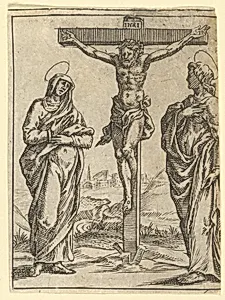
The Virgin of Sorrows: The Crucifixion; one of nine surrounding compartments from the Virgin of Sorrows, now separated
by 1575
Medium
Engraving
Dimensions
Sheet: 2 13/16 × 2 1/16 in. (7.2 × 5.3 cm)
Classification
Prints
Department
Drawings and Prints
Museum
Metropolitan Museum of Art, New York, NY
Credit
Harris Brisbane Dick Fund, 1953
Accession Number
53.600.3492
Rights
Public Domain
Tags
Art Historical Context
This intimate engraving by Giorgio Ghisi captures a poignant moment from the Crucifixion, with the Virgin Mary gazing sorrowfully at the cross. Created by 1575 as one of nine surrounding compartments in a larger devotional composition known as the Virgin of Sorrows, the print was later separated, allowing each scene to stand alone. Ghisi, a skilled Italian printmaker active during the late Renaissance, specialized in detailed engravings that brought sacred narratives to a wider audience through the reproducible medium of print. Measuring just over two by three inches, the work demonstrates the remarkable precision of engraving techniques, where fine lines convey both emotional depth and architectural detail in the cross and figures. Such small-scale religious prints were popular in the 16th century for personal devotion, reflecting the Catholic Church’s emphasis on meditative imagery during the Counter-Reformation. Ghisi’s masterful use of light and shadow heightens the scene’s pathos, inviting viewers to contemplate Mary’s suffering alongside Christ’s sacrifice. Now in the Metropolitan Museum’s collection, this piece exemplifies how Renaissance printmakers blended artistry and spirituality to make profound biblical stories accessible beyond church walls.
About the Artist
Giorgio Ghisi · 1520–1582
Giorgio Ghisi (c. 1520–1582) was one of the most accomplished engravers of the Italian Renaissance, renowned for translating the monumental compositions of Raphael, Giulio Romano, and Michelangelo into the exacting medium of the burin. Born in Mantua, he trained in an environment shaped by the legacy of Giulio Romano's decoration of the Palazzo del Te, and the grandeur of that Mannerist tradition ...