
The Virtues Crushing the Vices, Strasbourg Cathedral
1853
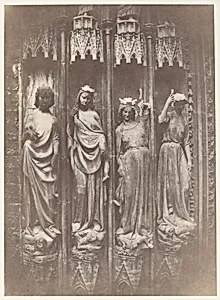
Medium
salted paper print
Dimensions
sheet: 61.1 x 44.5 cm (24 1/16 x 17 1/2 in.) image: 33.2 x 24.2 cm (13 1/16 x 9 1/2 in.)
Classification
Photograph
Department
CPH
Museum
National Gallery of Art, Washington, D.C.
Credit
Robert and Paula Hershkowitz in memory of Sam Wagstaff
Accession Number
2011.108.1
Rights
Public Domain
Art Historical Context
Welcome to the National Gallery of, where Charles Marville's *The Virtues Crushing the V, Strasbourg Cathedral* (1853) captures a moral allegory from one of grandest Gothic masterpieces. This salted paper print depicts a dramatic medieval sculpture on the cathedral's facade, where personified Virtues triumphantly subdue the grotesque Vices—a common theme in 13th-century Christian iconography meant to inspire piety and warn against sin. Strasbourg Cathedral, a UNESCO World Heritage site, exemplifies High Gothic architecture with its intricate stone carvings that blend spiritual symbolism and artistic virtuosity. Marville, a pioneering French photographer, masterfully documented this scene using the salted paper process, an early calotype technique that produced soft, tonal images from paper negatives. Created just a decade after photography's invention, this 33.2 x 24.2 cm image reflects the 1850s fascination with preserving historic monuments amid rapid modernization. Marville's precise composition highlights the sculpture's dynamic energy, making intricate details accessible to audiences far from Alsace. This photograph not only showcases Marville's skill in architectural photography but also underscores photography's emerging role in art history, bridging medieval devotion with 19th-century innovation. A gift from Robert and Paula Hershkowitz in memory of Sam Wagstaff, it invites us to ponder enduring battles between good and evil.
About the Artist
Charles Marville · 1813–1879
**Charles Marville**, born Charles François Bossu on July 17, 1813, in Paris, adopted his professional pseudonym around 1832 to avoid the stigma of "bossu," meaning hunchback in French. Trained as a painter, engraver, and illustrator, he spent nearly two decades producing woodblock illustrations for books and magazines before embracing photography around 1850. His transition coincided with the med...