
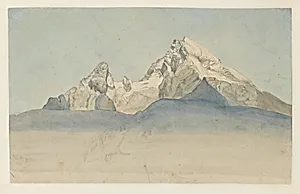
The Watzmann seen from the North-East, and Some Sketches of a Mountain; verso: Sketch of the Church of Sankt Bartholomä at the Königsee at the foot of the Watzmann Seen from the East
1820–22
Medium
Watercolor over a sketch in charcoal; verso, graphite. Framing line on the upper, left and right edges of the recto (possible by the artist).
Dimensions
sheet: 6 1/8 x 9 7/8 in. (15.5 x 25.1 cm)
Classification
Drawings
Department
Drawings and Prints
Museum
Metropolitan Museum of Art, New York, NY
Credit
Purchase, Lila Acheson Wallace, Charles and Jessie Price, and PECO Foundation Gifts, 2009
Accession Number
2009.124a, b
Rights
Public Domain
Tags
Art Historical Context
In the early 1820s, German artist August Heinrich captured the awe-inspiring Watzmann, one of the Bavarian Alps' highest peaks, in this intimate watercolor drawing. Created between 1820 and 1822, the recto features the mountain viewed from the northeast, overlaid with loose sketches of its rugged forms in charcoal and vibrant watercolor washes. This small sheet (15.5 x 25.1 cm) evokes the Romantic era's fascination with nature's sublime power, where artists ventured into the wild to sketch en plein air, celebrating the untamed beauty of the Alps. The verso reveals a graphite sketch of Sankt Bartholomä, the picturesque pilgrimage church nestled at the foot of the Watzmann on the emerald Königsee lake, viewed from the east. Heinrich's economical framing lines—possibly added by the artist—enhance the composition's focus. Watercolor over charcoal allowed for fluid, luminous effects ideal for capturing fleeting mountain light and atmosphere, a technique prized in landscape studies. These dual-sided works highlight Heinrich's keen observation during travels, blending topographic precision with emotional resonance. Displayed in the Metropolitan Museum of Art's Drawings and Prints department, this piece invites visitors to trace the Romantic impulse to immortalize Germany's majestic landscapes, bridging personal exploration and enduring artistic tradition.