
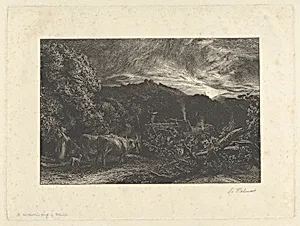
The Weary Ploughman, or The Herdsman, or Tardus Bubulcus
begun 1858
Medium
Etching; second or fourth state of eight, working proof
Dimensions
sheet: 10 3/8 x 13 3/4 in. (26.4 x 35 cm) plate: 7 1/2 x 10 5/16 in. (19 x 26.2 cm) image: 5 3/16 x 7 7/8 in. (13.2 x 20 cm)
Classification
Prints
Department
Drawings and Prints
Museum
Metropolitan Museum of Art, New York, NY
Credit
Gift of Theodore De Witt, 1923
Accession Number
23.65.7
Rights
Public Domain
Tags
Art Historical Context
Samuel Palmer's *The Weary Ploughman or The Herdsman or Tardus Bubul* (begun 1858) the timeless rhythm of rural labor in a delicate etching, a working proof from the second or fourth state of eight. This British visionary artist, known for his luminous pastoral scenes influenced by William Blake and Renaissance masters, here evokes a weary figure—perhaps a ploughman or herdsman—amidst animals and ancient trees. The intimate image size (5 3/16 x 7 7/8 in.) invites close contemplation, its etched lines rich with texture and depth. Etching, Palmer's favored medium in his later years, allowed meticulous refinement across states, as seen in this proof before final polishing. Drawing from classical sources like Virgil's *Georgics* (where "tardus bubulcus" describes the slow-moving oxherd), the work romanticizes agrarian life, blending 19th-century nostalgia for England's countryside with spiritual harmony. Palmer's Shoreham Ancients period had given way to these more classical visions, emphasizing nature's quiet grandeur. A gift to the Metropolitan Museum of Art in 1923, this print exemplifies Palmer's printmaking mastery, offering visitors a window into Victorian-era reverence for the pastoral ideal amid industrial change.
About the Artist
Samuel Palmer · 1805–1881
Samuel Palmer was born on 27 January 1805 in Newington, London, the son of a bookseller and sometime Baptist minister. He had little formal schooling and almost no conventional artistic training, yet he possessed an instinctive gift for drawing that led him to exhibit Turner-inspired works at the Royal Academy when he was only fourteen years old. In 1824 his mentor, the painter John Linnell, intro...