
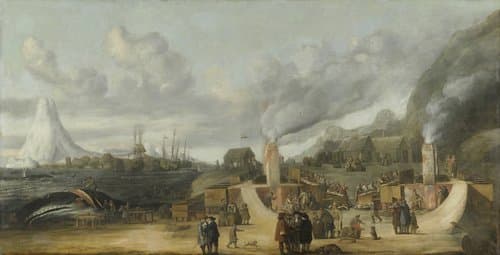
The Whale-oil Refinery near the Village of Smerenburg
1639
Medium
oil on canvas
Dimensions
131; 229; 10.5; 205; 108
Rights
Public Domain
About this artwork
oil on canvas
Art Historical Context
Cornelis de Man’s 1639 painting captures a bustling scene of industrial activity in the remote Arctic outpost of Smerenburg, a seasonal Dutch whaling settlement on the island of Spitsbergen. During the early seventeenth century, the Dutch Republic dominated the lucrative northern whale fishery, harvesting blubber that was rendered into oil for lighting, lubrication, and soap. The large canvas (over two meters wide) allows de Man to portray the full process—from flensing whales on the shore to boiling blubber in massive trypots—within a dramatic northern landscape of icy waters and makeshift wooden structures. Painted in oil on canvas, the work exemplifies the Dutch Golden Age interest in recording the nation’s global enterprises with meticulous detail. De Man balances the vast, chilly expanse of sky and sea with the warm glow of fires and the organized labor of workers, turning an everyday economic operation into a subject worthy of fine art. The painting thus serves as both a visual record of an industry that helped fuel the Dutch economy and a testament to the era’s fascination with exploration and commerce. Today in the Rijksmuseum, the canvas invites viewers to consider how seventeenth-century Dutch prosperity reached even the frozen edges of the known world. Its impressive scale and careful rendering of light and activity make the distant refinery feel immediate and alive.