
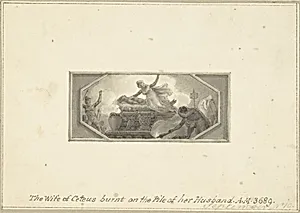
The Wife of Ceteus burnt on the Pile of her Husband
1790–1800
Medium
Pen and brown ink, brush and gray wash
Dimensions
Sheet: 3 1/8 × 4 1/2 in. (7.9 × 11.4 cm)
Classification
Drawings
Department
Drawings and Prints
Museum
Metropolitan Museum of Art, New York, NY
Credit
Gift of Spencer Bickerton, 1933
Accession Number
33.69.11
Rights
Public Domain
Tags
Art Historical Context
This intimate drawing by Edward Francis Burney captures a dramatic and somber scene titled *The Wife of Ceteus burnt on the Pile of her Husband*. Created between 1790 and 1800, the work depicts a ritualistic funeral pyre, with figures gathered around flames that symbolize both loss and sacrifice. The small scale—measuring just over three by four inches—invites close viewing, emphasizing the emotional intensity of the moment. Burney employed pen and brown ink with gray wash to render the composition, a technique that allows for precise linework combined with soft tonal shading. This medium heightens the contrast between the flickering fire and the surrounding figures, drawing attention to the human elements of grief and ritual. As a work on paper from the late eighteenth century, it reflects the period’s fascination with historical and exotic narratives. Housed in the Metropolitan Museum of Art’s Department of Drawings and Prints, the piece offers visitors a glimpse into themes of mortality and devotion. Its restrained palette and compact format make the tragic subject all the more poignant, encouraging reflection on cultural practices surrounding death.
About the Artist
Edward Francis Burney · 1760–1848
Comment on works: Portraits, history