
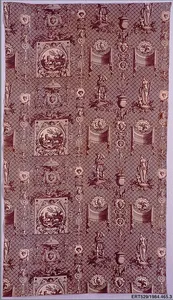
The Wolf and the Lamb (La Fontaine fable)
early 19th century
Medium
Cotton
Dimensions
L. 77 1/2 x W. 43 1/4 inches 196.9 x 109.9 cm
Classification
Textiles-Printed
Culture
French, Jouy-en-Josas
Department
European Sculpture and Decorative Arts
Museum
Metropolitan Museum of Art, New York, NY
Credit
Gift of Mildred R. Mottahedeh, 1984
Accession Number
1984.465.3
Rights
Public Domain
Tags
Art Historical Context
This printed cotton panel, created in the early 19th century by Jean-Baptiste Huet I, brings to life Jean de La Fontaine’s famous fable “The Wolf and the Lamb.” Produced in the renowned textile center of Jouy-en-Josas, France, the work belongs to the celebrated tradition of toiles de Jouy—narrative fabrics that adorned homes across Europe and America. Huet, a leading designer for the Oberkampf manufactory, specialized in lively scenes that combined storytelling with elegant ornament, here featuring animals and a coat of arms that add both moral and heraldic interest. Printed cotton offered an affordable yet refined alternative to woven tapestries, allowing complex illustrations to be reproduced on a large scale. Measuring over six feet in length, this textile would likely have served as furnishing fabric—perhaps for bed hangings or wall panels—transforming everyday interiors into spaces of gentle instruction and visual delight. Its presence in the Metropolitan Museum’s collection highlights the era’s taste for accessible luxury and the enduring appeal of La Fontaine’s moral tales. The piece reflects a moment when decorative arts carried both aesthetic pleasure and subtle lessons in virtue, making it a charming window into French domestic life around 1800.