
The Works of Publius Virgilius Maro: Translated, Adorned with Sculpture, and illustrated with Annotations
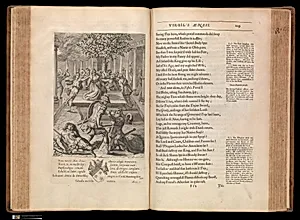
Medium
Illustrations: etching
Dimensions
16 7/16 x 10 5/8 x 1 5/8 in. (41.7 x 27 x 4.2 cm)
Classification
Books|Prints
Department
Drawings and Prints
Museum
Metropolitan Museum of Art, New York, NY
Credit
Harris Brisbane Dick Fund, 1917
Accession Number
17.3.2641(1)
Rights
Public Domain
Tags
Art Historical Context
Step into the world of 17th-century splendor with *The Works of Publiusilius Maro: Translated Adorned with Sculpture and Illustrated with Annotations* (1654), a magnificent English edition of the ancient Roman poet Virgil's masterpieces, including the *Aeneid*, *Georgics*, and *Eclogues*. Produced during England's turbulent Interregnum under Oliver Cromwell, this book represents a bold cultural endeavor by translator and publisher John Ogilby who aimed to make classical epics accessible and visually captivating to English readers. Its compact yet elegant dimensions—16 7/16 x 10 5/8 x 1 5/8 inches—belie the ambition of a volume blending poetry, scholarship, and artistry. The book's etchings, a refined printmaking technique using acid to incise intricate designs into metal plates, feature contributions from a stellar roster of engravers: Wenceslaus Hollar, William Faithorne the Elder, Pierre Lombart, Franz Cleyn, Sir Peter Lely, and others. These illustrations, evoking men, women, and coats of arms, likely depict mythological scenes, pastoral idylls, and heraldic motifs inspired by Virgil's timeless tales of heroism, love, and rural life. Etching allowed for delicate lines and tonal depth, elevating the book from mere text to a collector's treasure. Housed in the Metropolitan Museum of Art's Drawings and Prints department (acquired via the Harris Brisbane Dick Fund in 1917), this collaborative masterpiece underscores the era's revival of classical antiquity amid political upheaval, bridging Renaissance humanism with Baroque opulence. A testament to printing's golden age, it invites visitors to ponder how art immortalizes poetry across centuries.
About the Artist
Wenceslaus Hollar|Virgil|John Ogilby|Thomas Warren|Pierre Lombart|Franz Cleyn|John Ogilby|John Ogilby|Sir Peter Lely (Pieter van der Faes)|William Faithorne the Elder|L. Richer · 1607–1677
Wenceslaus Hollar (1607-1677) was a prolific Bohemian etcher who became one of the most accomplished printmakers of the seventeenth century. Born in Prague, he trained under Matthäus Merian in Frankfurt before entering the service of Thomas Howard, Earl of Arundel, in 1636. Hollar spent most of his career in England, where he produced approximately 2,740 etchings documenting an extraordinary range...