
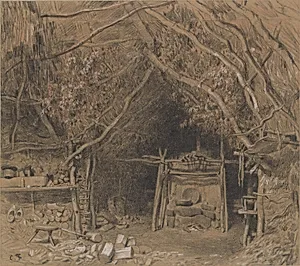
The Workshop of a Wooden Shoe Maker
ca. 1838
Medium
Black, white and red chalk on wove paper
Dimensions
Overall: 18 3/4 x 21 1/8in. (47.6 x 53.7cm) frame: 24 x 30 in. (61 cm)
Classification
Drawings
Department
Drawings and Prints
Museum
Metropolitan Museum of Art, New York, NY
Credit
Purchase, Chester Dale Bequest, by exchange, 1994
Accession Number
1994.49
Rights
Public Domain
Tags
Art Historical Context
Step into the cozy clutter of *The Workshop of a Wooden Maker*, a captivating drawing by French artist Constant Troyon from around 1838. Created with black, white, and chalk on wove papermeasuring 18¾ x 21⅛ inches—this piece captures the everyday rhythm of rural French craftsmanship. Troyon, who later gained fame in the Barbizon School for luminous landscapes and animal studies, here turns his keen eye to a humble genre scene, highlighting the labor-intensive world of sabot-making, those sturdy wooden clogs essential to 19th-century peasants and workers. The trois crayons technique—combining black for shadows, red for warm tones, and white for highlights—brings remarkable depth and texture to the workshop's tools, wood shavings, and half-finished shoes. Wove paper's smooth surface allowed Troyon's precise strokes to model forms vividly, showcasing his early mastery of draftsmanship before he embraced plein-air painting. This intimate study reflects Romanticism's fascination with authentic folk life amid France's industrial stirrings. Housed in the Metropolitan Museum of Art's Drawings and Prints department (purchase, Chester Dale Bequest, by exchange, 1994), it invites us to appreciate the artistry in ordinary toil—a timeless nod to artisans whose shoes treaded history's paths.
About the Artist
Constant Troyon · 1810–1865
After training to become a porcelain painter at Sèvres, Troyon became interested in 17th century Dutch landscape painting, particularly the work of Jacob van Ruisdael, and subsequently became a member of the Barbizon School. After becoming Chevalier de le Légion d'honneur in 1849, his work shifted from landscapes to the painting of animals, often with laborers. His later landscapes of Normady were...