
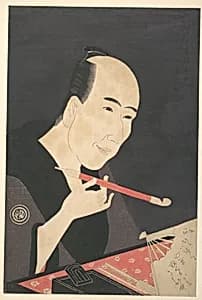
The Writer Santō Kyōden (a.k.a. Kitao Masanobu)
ca. 1795
Medium
Woodblock print; ink and color on paper
Dimensions
15 3/8 x 10 1/4 in. (39.1 x 26 cm)
Classification
Prints
Culture & Period
Japan · Edo period (1615–1868)
Department
Asian Art
Museum
Metropolitan Museum of Art, New York, NY
Credit
The Howard Mansfield Collection, Purchase, Rogers Fund, 1936
Accession Number
JP2419
Rights
Public Domain
Tags
Art Historical Context
Step into the lively world of Edo-period Japan1615–1868) with *The Writer Santō Kyōden (a.k.a. Kitao Masanobu)*, a stunning woodblock print by Chōōsai Eiri around 1795. This intimate portrait captures the renowned writer and artist Santō Kyōden, a literary sensation known for his witty *kibyōshi* (satirical yellow-backed novels) playful illustrations. Depicted with a fan and—symbols of refined leisure—Kyōden embodies the era's *ukiyo-e* spirit, or "pictures of the floating world," celebrating urban pleasures amid Japan's booming print culture. Eiri, a master of the ukiyo-e school influenced by elegant styles like those of Utamaro, employed intricate woodblock techniques: carved blocks inked with vibrant colors and layered onto paper for vivid depth and subtle gradients. At 15⅜ × 10¼ inches, this *ōban* format print was affordable and mass-produced, making art accessible to merchants and commoners. Its presence in the Metropolitan Museum of Art's Asian Art collection, from the Howard Mansfield bequest, highlights the global fascination with Japan's artistic ingenuity. This work not only immortalizes Kyōden's charisma but also reflects Edo society's blend of literature, theater, and visual splendor, offering a window into a transformative cultural moment.