
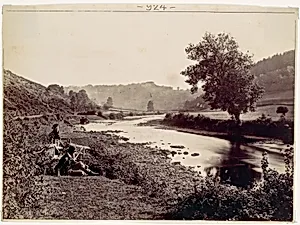
The Wye and Symond's Yat. From Rocklands
1870s
Medium
Albumen silver print from glass negative
Classification
Photographs
Department
Photographs
Museum
Metropolitan Museum of Art, New York, NY
Credit
The Elisha Whittelsey Collection, The Elisha Whittelsey Fund, 1972
Accession Number
1972.567.7
Rights
Public Domain
Tags
Art Historical Context
In the 1870s, British photographer Francis Bedford captured the allure of the River Wye inThe Wye and Sym's Yat. From Rock*, an exquisite albumen silver print made from a glass negative. image frames the dramatic landscape of Symonds Yat—a viewpoint in England's Herefordshire and Gloucestershire borderlands—where the river carves through wooded cliffs, evoking the Romantic ideal of untamed natural beauty. Bedford a pioneering Victorian photographer known for his precise topographic views and royal commissions (including travels with the Prince of Wales), elevated everyday scenery into art through his keen eye for composition and light. The albumen silver process, dominant in the mid-19th century, lent this print its signature warm tones, sharp details, and subtle gradations, making it a technical marvel of early photography. Prints like this fueled the era's growing tourism and appreciation for Britain's picturesque riverscapes, documenting sites like Symonds Yat that drew artists and visitors alike. Today, housed in The Metropolitan Museum of Art's Elisha Whittelsey Collection, it offers a window into how photography bridged art and exploration, preserving fleeting vistas for generations.
About the Artist
Francis Bedford · 1816–1894
Francis Bedford (1816–1894) was a pioneering British photographer, born in London as the eldest son of the church architect Francis Octavius Bedford.) He trained as an architectural draughtsman and lithographer, exhibiting drawings of architectural subjects from his late teens and listing "Lithographic Artist" as his profession in the 1851 census.) In the early 1850s, Bedford turned to photography...