
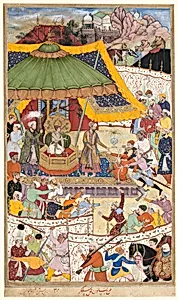
The Young Emperor Akbar Arrests the Insolent Shah Abu’l-Maali, Page from a Manuscript of the Akbarnama
Mughal dynasty (1526-1857), c. 1590-1595
Medium
Opaque watercolor and gold on paper
Dimensions
Image: 32 × 19.3 cm (12 5/8 × 7 9/16 in.); Outermost border: 33 × 19.6 cm (13 × 7 11/16 in.); Page: 34.4 × 20 cm (13 1/2 × 7 7/8 in.)
Classification
painting
Department
Arts of Asia
Museum
Art Institute of Chicago
Accession Number
76816
Rights
Public Domain
About this artwork
This is a page from the Akbarnama (Book of Akbar), a lavishly illustrated manuscript commissioned by the Mughal emperor Akbar (reigned 1556–1605) to document the history of his rule. The scene shows the emperor at age thirteen, three days after his accession. Seated on a gold throne on a carpeted platform, Akbar watches as his late father’s favorite courtier is arrested for his insolent behavior toward the young emperor. The setting—a tented encampment pitched in a garden—is significant, for Akb...
Art Historical Context
This vibrant page from the *Akbarnama*, the grand illustrated biography of Mughal Emperor Akbar, captures a pivotal moment in his early reign: the young Akbar boldly arresting the insolent Shah Abu’l-Maali around 1560. Created by the master miniaturist Basawan circa 1590–1595 during the height of the Mughal dynasty (1526–1857), it exemplifies the opulent court art commissioned by Akbar to chronicle his triumphs and legitimize his rule. The *Akbarnama*, compiled by his court historian Abu’l-Fazl, blended Persian literary traditions with Indian visual storytelling, making history vivid and accessible. Basawan, one of Akbar’s favored artists, shines here with his signature naturalism and dynamic composition. Figures are rendered with lifelike expressions—Akbar’s determined gaze contrasting the rebel’s defiance—set against a lush architectural backdrop of arches and gardens. The medium of opaque watercolor and gold on paper creates jewel-like intensity: brilliant hues glow under burnished gold highlights, a technique perfected in Mughal ateliers that fused Persian finesse with local Indian vibrancy. At 32 × 19.3 cm, its intimate scale invites close viewing, revealing intricate details like flowing robes and patterned tiles. As a gem from the Art Institute of Chicago’s Arts of Asia collection, this folio highlights Mughal painting’s cultural pinnacle—patronage fostering innovation, religious tolerance, and imperial narrative. It transports visitors to Akbar’s Delhi court, where art immortalized power and drama.