
Théâtre Italien (Gioacchino Rossini, 1792–1868)
1821
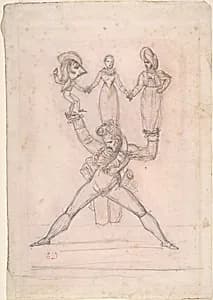
Medium
Graphite with brush and brown wash; red chalk applied to verso for image transfer
Dimensions
sheet: 10 1/2 x 7 1/2 in. (26.6 x 19 cm)
Classification
Drawings
Department
Drawings and Prints
Museum
Metropolitan Museum of Art, New York, NY
Credit
Purchase, Karen B. Cohen Gift, 2004
Accession Number
2004.197
Rights
Public Domain
Tags
Art Historical Context
Eugène Delacroix'sThéâtre Italien (acchino Rossini,1792–1868)*, created in 1821, offers a captivating glimpse into early 19th-century Parisian cultural life. At just 23, the young Delacroix—destined to become a cornerstone of Romanticism—sketched a lively scene at the Théâtre Italien, the city's premier venue for Italian opera. The drawing evokes the theatrical energy of the era, with tags highlighting men, women, andats, suggesting a dynamic performance tied to the composer Gioacchino Rossini whose operas like *Il barbiere di Siviglia* were electrifying audiences. Rendered on a modest 10½ × 7½-inch sheet, the work showcases Delacroix's masterful mixed media: graphite for precise lines, brush and brown wash for dramatic shading, and red chalk applied to the verso for image transfer—a clever technique hinting at his preparatory process for larger compositions. This innovative approach underscores his early experimentation, blending technical precision with the Romantic emphasis on movement and emotion. Housed in the Metropolitan Museum of Art's Drawings and Prints department (purchased with the Karen B. Cohen Gift in 2004), this piece captures the buzz of Rossini's influence on European music and theater. It reminds us how Delacroix drew inspiration from live spectacle, foreshadowing his later exuberant paintings filled with passion and vitality. A true gem for lovers of Romantic draftsmanship!
About the Artist
Eugène Delacroix · 1798–1863
Eugène Delacroix (1798–1863) stands as the defining figure of French Romanticism and a pivotal bridge to modernism. Born in Charenton-Saint-Maurice near Paris, he came from distinguished lineage—his mother descended from the prestigious Oeben-Riesener furniture dynasty, while persistent speculation suggested the statesman Talleyrand may have been his biological father, a theory supported by physic...