
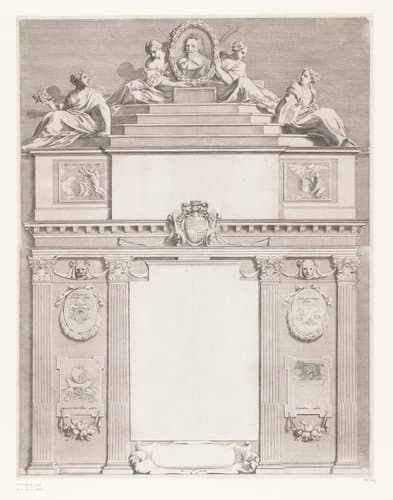
These over logica en moraal van Michel Sublet de Romilly (bovendeel)
1643 - 1688
Medium
engraving
Dimensions
291; 439
Rights
Public Domain
About this artwork
plaatrand: breedte 291 mm (Binnen plaatrand afgesneden.)
Art Historical Context
Behold the upper section of Claude Mellan's striking 17th-century engraving, *Theses over logica en moraal van Michel Sublet de Romilly (bovendeel)*, a testament to the era's fusion of scholarship and artistry. Created between 1643 and 1688, this large-scale work (439 × 291 mm) captures the intellectual rigor of Michel Sublet de Romilly's theses on logic and morals, likely produced for an academic defense or publication. Mellan, a masterful French engraver renowned for his intricate line work, elevates what might have been a dry dissertation into a visually compelling artifact. Engraving, Mellan's preferred medium, allowed for precise reproduction of text and imagery, making scholarly works accessible across Europe during the Baroque period. This technique involved incising designs into metal plates with a burin, then printing under pressure for rich, detailed impressions. Note the plate border, trimmed to 291 mm wide, which hints at the print's original grandeur now preserved in a slightly altered form. In the context of 17th-century humanism, such prints bridged philosophy and visual culture, disseminating Enlightenment-era ideas on ethics and reason. Mellan's contribution underscores engraving's role as a democratic tool for knowledge, inviting us to ponder Romilly's arguments while marveling at the engraver's technical virtuosity. A window into the scholarly salons of old Europe!
About the Artist
Claude Mellan · 1598–1688
Claude Mellan (1598-1688) was a French draughtsman, engraver, and painter who became one of the most innovative printmakers of the French Baroque period. Born in Abbeville to a family of coppersmiths, Mellan rose to become Peintre et Graveur Ordinaire du Roi (Painter and Engraver in Ordinary to the King), achieving recognition for his extraordinary technical mastery. Mellan's artistic significanc...