
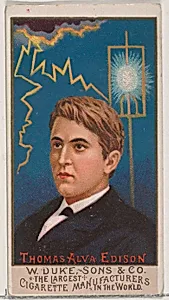
Thomas Alva Edison, from the series Great Americans (N76) for Duke brand cigarettes
Medium
Commercial color lithograph
Dimensions
Sheet: 2 3/4 × 1 1/2 in. (7 × 3.8 cm)
Classification
Prints|Ephemera
Department
Drawings and Prints
Museum
Metropolitan Museum of Art, New York, NY
Credit
The Jefferson R. Burdick Collection, Gift of Jefferson R. Burdick
Accession Number
63.350.204.76.10
Rights
Public Domain
Tags
Art Historical Context
This petite chromolithograph, titled *Thomas Alva Edison* the *Great Americans (N76)* series, was produced in 1888 by W. Duke, Sons & Co., a leading tobacco firm. Measuring just 2¾ × 1½ inches, it served as a collectible insert in Duke brand cigarette packs, capitalizing on the era's booming cigarette trade and public fascination with American heroes. Thomas Edison, the famed inventor of the phonograph and practical incandescent light bulb, is depicted in a dignified portrait, embodying the Gilded Age's spirit of innovation and progress. Chromolithography, the medium here, revolutionized commercial printing by allowing vibrant, multi-color images at low cost—perfect for mass-market ephemera like these cards. Duke's series celebrated luminaries from politics, science, and arts, fostering collector enthusiasm and subtly promoting their product amid fierce competition from rivals like Allen & Ginter. Part of The Metropolitan Museum of Art's Jefferson R. Burdick Collection, this piece highlights early advertising's role in shaping celebrity culture and consumer habits. A tiny window into 19th-century commerce, it reminds us how everyday objects immortalized icons like Edison, blending art, history, and hustle.
About the Artist
W. Duke, Sons & Co. · 1870–1920
**W. Duke, Sons & Co.: Pioneers of Chromolithographic Trade Card Art** W. Duke, Sons & Co., an American tobacco manufacturer, emerged from the entrepreneurial vision of Washington Duke (1820–1905) and his sons in Durham, North Carolina. After the Civil War, Washington abandoned farming in 1874 to join his eldest son, Brodie L. Duke, in the burgeoning tobacco trade, establishing a factory that for...