
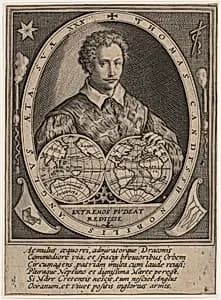
Thomas Cavendish
published 1598
Medium
engraving
Dimensions
sheet: 13.4 × 9.7 cm (5 1/4 × 3 13/16 in.)
Classification
Department
CG-E
Museum
National Gallery of Art, Washington, D.C.
Credit
Rosenwald Collection
Accession Number
1950.14.270
Rights
Public Domain
Art Historical Context
**Thomas Cavendish**, a finely detailed engraving by Flemish-Dutch artist Crispijn de Passe I captures the likeness of the renowned English explorer and privateer (1555–1592). Published 1598, this portrait measures just 13.4 × 9.7 cm, typical of small-scale prints designed for wide dissemination in books or collections during the late Elizabethan era. De Passe, a master engraver from a prominent family of printmakers, renders Cavendish with precise line work, emphasizing his stern gaze and period attire to evoke authority and adventure. Cavendish holds a pivotal place in maritime history as the second Englishman—after Sir Francis Drake—to circumnavigate the globe (1586–1588), plundering Spanish treasure ships along the way and amassing a fortune in gold and jewels. Created six years after his death at sea, this print likely served as a commemorative tribute amid England's rising naval prowess and the cultural fascination with exploration during the Age of Discovery. As an engraving, the work showcases de Passe's expertise in intaglio techniques, where intricate burrs and cross-hatching create rich tonal depth on a metal plate, allowing for multiple high-quality impressions. Housed in the National Gallery of Art's Rosenwald Collection, it exemplifies how prints democratized portraiture, bringing heroic figures like Cavendish into homes and fostering national pride in an era of global rivalry.
About the Artist
Crispijn de Passe I
Crispijn de Passe I, born around 1564 in Arnemuiden, Zeeland, emerged as one of the most influential Dutch engravers and print publishers of his era. He relocated to Antwerp as a youth, where he honed his craft amid the city's vibrant printmaking scene, becoming an independent master in the Guild of Saint Luke by 1584–1585. There, he worked as a reproductive engraver, primarily after designs by pr...