
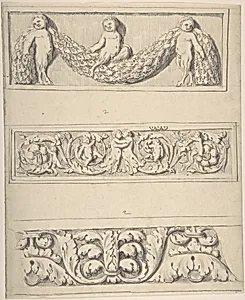
Three Frieze Designs with Young Satyrs, Leaves, Vines, and Putti
1776–79
Medium
Graphite
Dimensions
sheet: 11 9/16 x 9 3/8 in. (29.4 x 23.8 cm)
Classification
Drawings|Ornament & Architecture
Department
Drawings and Prints
Museum
Metropolitan Museum of Art, New York, NY
Credit
Harris Brisbane Dick Fund, 1934
Accession Number
34.78.2(86)
Rights
Public Domain
Tags
Art Historical Context
This delicate graphite drawing by British architect Thomas Hardwick captures three elegant frieze designs brimming with classical motifs. Created between 1776 and 1779, the sheet showcases playful young satyrs intertwined with curling vines, leafy garlands, and cheerful putti—figures drawn from ancient Roman and Greek ornament. Rendered with precise, light strokes on a modest sheet measuring roughly 11 by 9 inches, the work reflects Hardwick’s careful study of decorative patterns suitable for architectural embellishment. Dating to the height of the neoclassical revival, these designs echo the period’s fascination with antiquity, sparked by recent archaeological discoveries at sites like Pompeii and Herculaneum. Hardwick, who trained under Sir William Chambers and traveled in Italy, used such studies to inform his own building projects, translating two-dimensional sketches into carved stone or plaster reliefs that adorned public and private spaces. As a work classified under Ornament and Architecture, the drawing offers a rare glimpse into the creative process behind neoclassical interiors. Its presence in the Metropolitan Museum’s collection highlights how 18th-century designers bridged fine art and functional decoration, preserving timeless motifs of nature and mythology for future generations.