
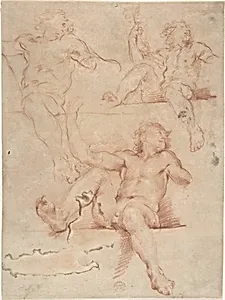
Three Studies of Seated Nude Male with Raised Arm, Seen from Below.
17th century
Medium
Red chalk, on light brown paper. Partly reworked with red crayon
Dimensions
10-3/8 x 7-3/4 in. (26.4 x 19.7 cm)
Classification
Drawings
Department
Drawings and Prints
Museum
Metropolitan Museum of Art, New York, NY
Credit
Gift of Cornelius Vanderbilt, 1880
Accession Number
80.3.264
Rights
Public Domain
Tags
Art Historical Context
This striking sheet of studies, created by an anonymous Bolognese artist in the seventeenth century, captures three dynamic views of a seated male nude seen from below. Executed in red chalk on light brown paper and partly reworked with red crayon, the drawing exemplifies the academic practice of the period, when artists meticulously recorded the human figure from multiple angles to master anatomy, foreshortening, and the play of light across form. Such preparatory sketches were essential tools for painters working on larger compositions, from altarpieces to fresco cycles. The Bolognese school placed particular emphasis on life drawing and classical ideals, influences that are evident in the careful modeling and rhythmic contours of these figures. Red chalk, prized for its warm tonal range and ability to suggest both delicate shading and bold contour, allowed the artist to explore subtle muscular tension and the dramatic upward perspective. The sheet’s modest size—just over ten inches high—belies its expressive power and technical sophistication. Acquired by the Metropolitan Museum in 1880 as a gift from Cornelius Vanderbilt, the drawing offers visitors a vivid glimpse into the working methods of Baroque-era studios and the enduring fascination with the male nude as a vehicle for artistic study.