
Tile
Unknown Artist
1640–60
Medium
Tin-glazed earthenware
Dimensions
Overall (tile): 5 5/16 × 5 5/16 × 1/2 in. (13.5 × 13.5 × 1.3 cm); Overall (whole panel): 31 3/4 × 21 1/2 in. (80.7 × 54.6 cm)
Classification
Ceramics-Pottery
Culture
Dutch
Department
European Sculpture and Decorative Arts
Museum
Metropolitan Museum of Art, New York, NY
Credit
Gift of W. R. Valentiner, 1908
Accession Number
08.196.54
Rights
Public Domain
Tags
Art Historical Context
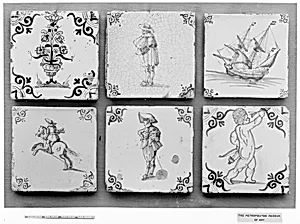
This exquisite Dutch tile panel, created between 1640 and 1660 during the Netherlands' Golden Age, exemplifies artistry of tin-glazed earthen, a hallmark of Delft pottery production. Composed of numerous square tiles measuring about 5⅜ inches each, the full panel spans over 31 by 21 inches, originally designed for interior decoration like fireplaces or walls in prosperous homes. Gifted to the Metropolitan Museum of Art 1908 by W.R. Valentiner, it the anonymous artist's skill in vibrant blue-and-white glazes over earthenware, a technique borrowed from Italian maiolica but perfected by Dutch potters for mass appeal. Vivid scenes of horses, men, women, and ships animate the surface, capturing the era's seafaring prowess and everyday life. These narrative motifs—common in 17th-century Delftware—evoke maritime adventures and equestrian pursuits, reflecting the Dutch Republic's dominance in global trade and its thriving merchant class. The tin glaze provided a smooth, impermeable surface ideal for moisture-prone kitchens, while the cobalt-blue designs under a clear lead glaze created luminous, enduring colors fired at high temperatures. As an accessible art form, these tiles democratized decoration, adorning burgher households with storytelling panels that blended utility and beauty. Today, this panel offers a window into the cultural vibrancy of the Dutch Golden Age, where pottery rivaled painting in narrative power.