
Tile Panel
Unknown Artist
early 17th century
Medium
Stonepaste; painted and glazed
Dimensions
H. 22 in. (55.9 cm) W. 22 in. (55.9 cm) D. 2 in. (51.1 cm)
Classification
Ceramics-Tiles
Department
Islamic Art
Museum
Metropolitan Museum of Art, New York, NY
Credit
Rogers Fund, 1907
Accession Number
07.190.17
Rights
Public Domain
Art Historical Context
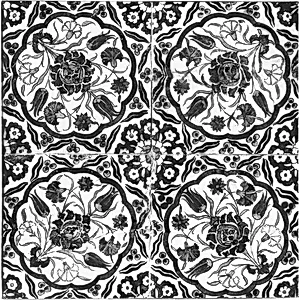
Welcome to the Islamic Art galleries, where this striking **Tile Panel** from early 17th century transports visitors to the opulent world of Ottoman or Safavid architectural splendor. Crafted by an unknown artist, this square panel measures a compact yet impactful 22 x 22 inches (55.9 x 55.9 cm), with a depth of 2 (5.1 cm). Acquired through the Rogers Fund in 7, it exemplifies the exquisite ceramics tradition of the Islamic world. Made from stonepaste—a refined composite of quartz, clay, and frit—this medium allowed artisans to create a durable, ivory-white body ideal for intricate designs. The surface is painted with vibrant pigments under a glossy glaze, fired to produce luminous blues, greens, and golds that catch the light beautifully. Such techniques, perfected in regions like Persia (modern Iran) and the Ottoman Empire, enabled tiles to withstand centuries while adorning mosques, palaces, and baths. These panels were integral to Islamic decorative arts, forming vast mosaics that evoked paradise gardens with floral motifs and geometric patterns symbolizing infinity and divine order. Though details of its exact design are subtle here, it reflects the era's mastery in blending functionality with breathtaking beauty, inviting contemplation of a vibrant cultural heritage.