
Tip Table
1935/1942
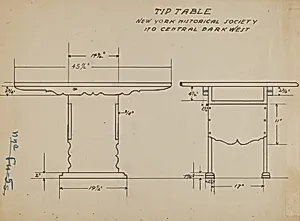
Medium
pen and ink and graphite on paper
Dimensions
overall: 21.1 x 27.9 cm (8 5/16 x 11 in.) Original IAD Object: c. 45"wide x 19 1/4"high. See scale drawing (5661).
Classification
Index of American Design
Department
CG-W
Museum
National Gallery of Art, Washington, D.C.
Credit
Index of American Design
Accession Number
1943.8.5661
Rights
Public Domain
Art Historical Context
**Tip Table**, a meticulous rendering from the Index of American Design (AD), captures the elegance of early American furniture craftsmanship. Created between 1935 and 1942 by an anonymous th-century American artist, this pen-and-ink and graphite drawing on paper (21.1 x 27.9 cm) documents a tip table—a compact, versatile piece measuring approximately 45 inches wide by 19¼ inches high. The IAD, a Federal Art Project under the Works Progress Administration the Great Depression, employed artists to produce precise illustrations of everyday American objects, preserving cultural heritage amid economic hardship. The drawing's fine lines and shading highlight the table's functional design, likely featuring a tilt-top mechanism ideal for serving tea or displaying wares in colonial homes. Such tables embodied practical ingenuity in 18th- or 19th-century American households, blending utility with modest ornamentation. A referenced scale drawing (no. 5661) underscores the IAD's commitment to accuracy, making this work both an artistic study and a historical blueprint. Housed in the National Gallery of Art's Index of American Design collection, *Tip Table* celebrates the unsung artistry of vernacular design. It invites visitors to appreciate how WPA-era efforts safeguarded stories of American ingenuity for future generations.
About the Artist
American 20th Century · 1900–1999
"American 20th Century" is the designation used by major institutions such as the National Gallery of Art (NGA) for anonymous and unidentified artists active in the United States during the twentieth century. The artist's personal identity, early life, and training remain undocumented, reflecting the challenges of attribution for unattributed works from this era. No specific teachers, art schools,...