
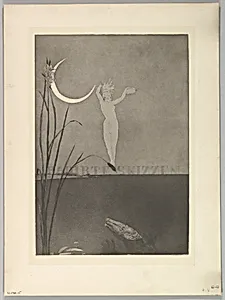
Titelblatt, from the series "Radierte Skizzen"
n.d.
Medium
Etching and aquatint on chine collé
Dimensions
Image: 14 15/16 × 10 7/16 in. (38 × 26.5 cm) Sheet: 19 7/8 × 14 3/4 in. (50.5 × 37.5 cm)
Classification
Prints
Department
Drawings and Prints
Museum
Metropolitan Museum of Art, New York, NY
Credit
Gift of the Estate of Mrs. Edward Robinson, 1952
Accession Number
52.594.15
Rights
Public Domain
Tags
Art Historical Context
Max Klinger's *Titelblatt* serves as the evocative title page for his series *Radierte Skzen* (Etched Sketches), testament to the German artist's mastery of printmaking in the late 19th century Klinger (1857–1920), a key figure in Symbolism, blended realism with fantastical elements, drawing from Romanticism and Japonisme to explore dreams, mythology, and the subconscious. This undated etching captures his penchant for surreal vignettes, featuring female nudes, menacing crocodiles, and a luminous moon—symbols evoking eroticism, danger, and cosmic mystery. The medium of etching and aquatint on chine collé highlights Klinger's technical innovation. Etching provides precise lines for intricate details, while aquatint adds velvety tonal depths, mimicking painting's richness on paper. Chine collé, a thin Asian paper adhered to a sturdy support, allowed for delicate textures and vibrant inks, a technique Klinger perfected in his graphic cycles, rivaling paintings in expressiveness. Housed in the Metropolitan Museum of Art's Drawings and Prints department (gift of the Estate of Mrs. Edward Robinson, 1952), it exemplifies how prints democratized Symbolist visions for wider audiences. This work invites viewers into Klinger's imaginative realm, where the interplay of beauty and peril reflects fin-de-siècle anxieties and fascinations, making it a captivating entry to his etched world.
About the Artist
Max Klinger · 1857–1920
Max Klinger, born on February 18, 1857, in Leipzig to a wealthy family, emerged as one of Germany's most innovative artists across painting, sculpture, printmaking, and graphics. Demonstrating early talent, he enrolled at the Academy of Fine Arts in Karlsruhe in 1874 as a pupil of Karl Gussow, following his teacher to the Berlin Academy upon Gussow's appointment as director, and graduated in 1877 ...