
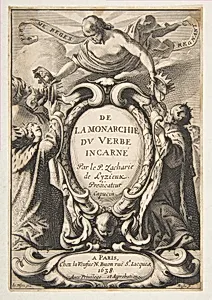
Title-page: De la Monarchie du Verbe incarné
Medium
Etching
Dimensions
Sheet: 7 1/16 × 4 13/16 in. (18 × 12.3 cm)
Classification
Prints
Department
Drawings and Prints
Museum
Metropolitan Museum of Art, New York, NY
Credit
Purchase, The Elisha Whittelsey Collection, The Elisha Whittelsey Fund, 1966
Accession Number
66.630.59
Rights
Public Domain
Tags
Art Historical Context
Welcome to the Metropolitan Museum of Art's Drawings and Prints department, where we showcase this exquisite 1638 etching: *Title-page: De la Monarchie Verbe incarné*. Created as a collaborative effort by master etcher Abraham Bosse, Laurent de La Hyre and printed by La Veuve N. Buon Paris, this small yet intricate sheet (7 1/16 × 4 13/16 in.) served as the ornate frontispiece for a French theological treatise on the "Monarchy of the Incarn Word"—a profound exploration of Jesus Christ's divine kingship. Bosse, renowned for his precise line work and innovations in etching technique, captures a reverent scene likely featuring Christ amid male figures, evoking the Counter-Reformation's emphasis on sacred imagery during Louis XIII's reign. Etching allowed for fine, expressive details in such book illustrations, blending La Hyre's classical elegance with Bosse's technical mastery. This print reflects 17th-century France's vibrant print culture, where religious devotion met artistic innovation to inspire faith among readers. Acquired in 1966 through The Elisha Whittelsey Fund, it stands as a gem of Baroque-era printmaking, highlighting how etchings democratized elaborate religious art for scholarly texts. A testament to collaboration and piety, it invites you to ponder the eternal "Verbe incarné" in delicate lines.
About the Artist
Abraham Bosse|Laurent de La Hyre|La Veuve N. Buon, Paris · 1602–1676
Abraham Bosse (1604–1676) was a French printmaker and theorist whose approximately 1,600 etchings provide an unparalleled visual record of 17th-century French life. Born to Huguenot parents in Tours, he trained in Paris under Melchior Tavernier and became a devoted follower of Jacques Callot's technical innovations. Bosse's meticulous etchings depicted subjects ranging from daily life and fashion ...