
Title Page
1883
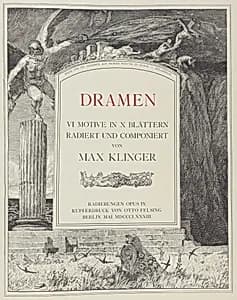
Medium
cliché-verre in wove paper
Dimensions
sheet: 63 x 45 cm (24 13/16 x 17 11/16 in.)
Classification
Portfolio
Department
CG-E
Museum
National Gallery of Art, Washington, D.C.
Credit
Gail and Benjamin Jacobs Fund
Accession Number
2011.71.1
Rights
Public Domain
Art Historical Context
Max Klinger's *Title Page* (1883) serves as an elegant introduction to one of his innovative print portfolios, showcasing the German artist's mastery of Symbolist graphic arts. Born in 1857, Klinger was a pivotal figure in 19th-century European, blending meticulous draftsmanship with fantastical imagery influenced by Romanticism and emerging Symbolism. This sheet, measuring 63 x 45 cm, exemplifies his experimental spirit during a period when artists pushed boundaries between traditional printmaking and photography. The medium—cliché-verre on wove paper—is particularly noteworthy. This rare 19th-century technique involved drawing directly on a glass plate with ink or chemicals, then contact-printing it onto paper to create unique, painterly effects with subtle tonal gradations. Klinger's use of cliché-verre allowed for a dreamlike fusion of hand-drawn precision and photographic reproducibility, bridging art and science in an era of rapid technological change. As part of the National Gallery of Art's collection (acquired through the Gail and Benjamin Jacobs Fund), it highlights his role in advancing print portfolios as cohesive artistic statements. For visitors, this understated yet sophisticated title page invites reflection on Klinger's visionary approach, where even introductory elements carry symbolic weight, evoking mystery and the subconscious in the fin-de-siècle imagination.
About the Artist
Max Klinger · 1857–1920
Max Klinger, born on February 18, 1857, in Leipzig to a wealthy family, emerged as one of Germany's most innovative artists across painting, sculpture, printmaking, and graphics. Demonstrating early talent, he enrolled at the Academy of Fine Arts in Karlsruhe in 1874 as a pupil of Karl Gussow, following his teacher to the Berlin Academy upon Gussow's appointment as director, and graduated in 1877 ...