
To J. Brahms
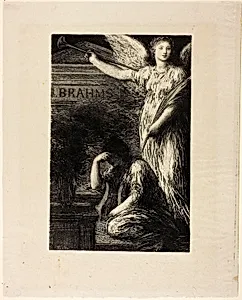
Medium
Lithograph in black on off-white chine
Dimensions
Image: 24.6 × 16 cm (9 11/16 × 6 5/16 in.); Sheet: 33.9 × 26.9 cm (13 3/8 × 10 5/8 in.)
Classification
lithograph
Department
Prints and Drawings
Museum
Art Institute of Chicago
Accession Number
44217
Rights
Public Domain
Art Historical Context
Henri Fantin-Latour's *To J. Brahms* (1898) is a poignant lithograph honoring the renowned German composer Johannes Brahms who had passed away the previous year. Created shortly after Brahms's death, this intimate portrait captures the musician's thoughtful visage, reflecting Fantin-Latour's deep admiration for his subject's profound artistry. The French painter and printmaker, known for his precise Realism and evocative depictions of fellow artists and musicians, bridged visual and musical worlds through works like this, fostering cultural dialogue in late 19th-century Europe. Printed in black ink on delicate off-white chine—a thin, translucent paper applied to a stronger support—this lithograph exemplifies the medium's versatility. Lithography allowed Fantin-Latour to achieve velvety tones and subtle gradations, mimicking the richness of oil painting while enabling affordable dissemination. Measuring just 24.6 × 16 cm, its compact scale invites close contemplation, much like a personal homage. Housed in the Art Institute of Chicago's Prints and Drawings department, this piece underscores Fantin-Latour's legacy in graphic arts and his role in immortalizing Romantic-era luminaries. For visitors, it offers a window into the intertwined worlds of music and visual culture at the fin de siècle.
About the Artist
Henri Fantin-Latour · 1836–1904
Ignace Henri Jean Théodore Fantin-Latour was born on January 14, 1836, in Grenoble, France, to portrait painter Théodore Fantin-Latour, who gave him his earliest drawing lessons. The family relocated to Paris in 1841, where in 1850, at age 14, he enrolled in the École de Dessin, studying under Horace Lecoq de Boisbaudran, whose innovative memory-based method of drawing from observation profoundly ...