
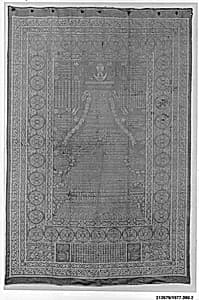
Tolobei (tomb cover)
Unknown Artist
19th century
Medium
Silk, metallic thread
Dimensions
92 x 61 1/4 in. (233.68 x 155.57 cm)
Classification
Textiles-Woven
Culture & Period
China · Qing dynasty (1644–1911)
Department
Asian Art
Museum
Metropolitan Museum of Art, New York, NY
Credit
Gift of Mr. and Mrs. N. Holmes Clare, 1977
Accession Number
1977.390.2
Rights
Public Domain
Art Historical Context
This exquisite *Tolobei*, or tomb cover, hails from 19th-century China during the Qing dynasty (164–1911), a of imperial splendor and cultural. Crafted by an unknown artist, this large woven textile—measuring nearly 8 by 5 feet—was likely used in funerary rituals, draping over tombs to honor the deceased. Its presence in the Metropolitan Museum of Art's Asian collection, gifted by Mr. and Mrs. N. Holmes Clare in1977, highlights the diversity of Chinese textile traditions beyond Han imperial courts, possibly reflecting influences from Muslim communities in regions like Xinjiang. Woven from luxurious silk and shimmering metallic threads, the *Tolobei* exemplifies advanced Qing-era weaving techniques. Silk, China's ancient "fabric of emperors," provided a smooth, vibrant base, while metallic threads added a radiant, otherworldly gleam, evoking spiritual protection and status. Such opulent materials were reserved for significant burials, blending practicality with artistry in a classification of textiles that preserved cultural memory. As a rare surviving example, this tomb cover offers a window into Qing society's multicultural fabric, where Confucian, Buddhist, and Islamic practices intertwined. Visitors can marvel at its scale and sheen, imagining it safeguarding ancestral spirits in a vibrant ceremony of remembrance.