
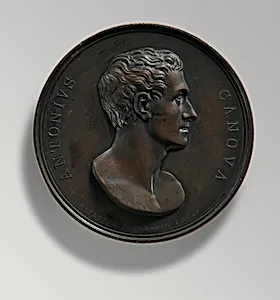
Tomb of Antonio Canova
1827
Medium
Bronze
Dimensions
Diameter: 2 1/16 in. (5.2 cm)
Classification
Medals and Plaquettes
Culture
Italian, Venice
Department
European Sculpture and Decorative Arts
Museum
Metropolitan Museum of Art, New York, NY
Credit
Gift of Michael Hall, 1967
Accession Number
67.219.1
Rights
Public Domain
Tags
Art Historical Context
In the heart of Venice's Basilica dei Frari lies the striking pyramidal tomb of Antonio Canova1757–1822), the preeminent neoclassical sculptor whose marble works revived ancient Greek ideals during the Napoleonic era. This intimate bronze medal, crafted by Venetian artist Antonio Fabris in 7—just five years after Canova death—serves as a poignant miniature tribute. Measuring a mere 2 1/16 inches in diameter, it captures the tomb's distinctive Egyptian-inspired pyramid form in profile, flanked by symbolic elements and possibly a portrait of the honored artist, evoking both reverence and classical grandeur. Fabris, working in the tradition of Venetian plaquette-makers, employed fine bronze casting or striking techniques to achieve crisp relief details, a hallmark of 19th-century medals that made architectural monuments portable and collectible. These small-scale sculptures were prized by Europe's cultured elite for their precision and as memorials to cultural heroes. Donated to the Metropolitan Museum of Art in 1967, this piece highlights Venice's enduring artistic legacy, blending funerary symbolism with neoclassical homage in a format that invites close contemplation. (198 words)