
Top for standard
Unknown Artist
ca. 8th–7th century BCE
Medium
Bronze
Dimensions
6 in. × 5 3/16 in. × 1 5/16 in. (15.3 × 13.2 × 3.4 cm)
Classification
Metalwork-Sculpture
Culture & Period
Iran · Iron Age III
Department
Ancient Near Eastern Art
Museum
Metropolitan Museum of Art, New York, NY
Credit
Edith Perry Chapman Fund, 1966
Accession Number
66.104.1
Rights
Public Domain
Tags
Art Historical Context
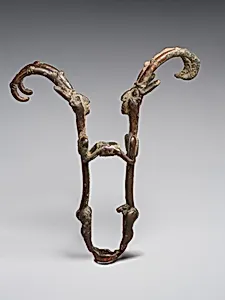
This enigmatic bronze "Top for Standard" hails from Iron Age III Iran, dating to around the 8th–7th BCE. Crafted as a small metalwork sculpture—measuring just 6 × 5 3/16 × 1 5/16 inches—it likely served as a finial a ceremonial pole or banner, carried in processions or used in rituals. Its compact size and durable bronze medium highlight the advanced casting techniques of ancient Iranian artisans, who excelled in producing intricate objects for elite or religious contexts. The piece stands out for its depiction of male and female nude figures, a bold artistic choice in Near Eastern art that may evoke themes of fertility, divinity, or human vitality. Nudity in such works often symbolized vulnerability, power, or sacred ideals, reflecting the cultural reverence for the body during this transitional era between Bronze and Iron Ages. Belonging to the Metropolitan Museum of Art's Ancient Near Eastern collection, acquired through the Edith Perry Chapman Fund in 1966, it offers a rare glimpse into Iran's pre-Achaemenid world, where metalwork bridged utility and symbolism. Though the artist remains unknown, this artifact's survival underscores bronze's enduring legacy in preserving fleeting moments of ancient life. Visitors, imagine it gleaming atop a standard amid dusty caravans— a testament to artistry that still captivates.