
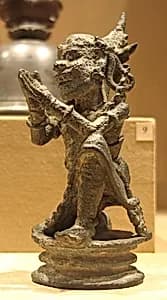
Top of a Bell in the Form of a Kneeling Demon
Unknown Artist
14th century
Medium
Bronze
Dimensions
H. 4 5/8 in. (11.8 cm)
Classification
Sculpture
Culture & Period
Indonesia (Java) · Eastern Javanese period
Department
Asian Art
Museum
Metropolitan Museum of Art, New York, NY
Credit
Gift of Mr. and Mrs. Walter Eisenberg, 1982
Accession Number
1982.460.2
Rights
Public Domain
Tags
Art Historical Context
This intriguing bronze sculpture, the *Top of a Bell in Form of a Kneeling*, hails from 14th-century Java during the Eastern Javanese, a golden era of Hindu-Buddhist kingdoms like Majapahit. Standing just 4 5/8 inches (11.8 cm) tall, it once crowned a ritual bell, likely used in temple ceremonies to summon divine forces or ward off malevolent spirits. The demon's kneeling pose—fierce yet submissive—embodies the Javanese artistic tradition of blending terror and protection, where such supernatural guardians flanked temple doors and sacred objects. Crafted in bronze through lost-wax casting, a sophisticated technique mastered by Javanese artisans, the piece showcases finely detailed musculature, horns, and fangs that capture the demon's otherworldly essence. Demons (often called *kala* or *raksasa*) held profound cultural significance, symbolizing chaos tamed by cosmic order and serving as apotropaic figures to repel evil. Today, this rare survivor graces the Metropolitan Museum of Art's Asian Art collection, a gift from Mr. and Mrs. Walter Eisenberg in 1982. It invites us to ponder the spiritual worldview of ancient Java, where even a humble bell top evoked the eternal dance of good and evil.