
Trade Card
January 1835
Medium
Black ink
Dimensions
2 1/4 x 3 5/8 in. (5.7 x 9.2 cm)
Classification
Drawings
Department
Drawings and Prints
Museum
Metropolitan Museum of Art, New York, NY
Credit
Dodge Fund, 1967
Accession Number
67.827.56
Rights
Public Domain
Art Historical Context
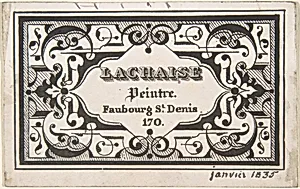
Step into the world of 19th-century commerce with *Trade Card*, a delicate black ink drawing by French artist Jules-Edmond-Charles Lachaise, created in January 1835. Measuring just 2¼ x 3⅝ inches (5.7 x 9.2 cm), this petite work exemplifies the ephemera of its era—small promotional cards distributed by businesses to advertise goods and services. Housed in the Metropolitan Museum of Art's Department of Drawings and Prints (acquired through the Dodge Fund in 1967), it captures the precision of ink on paper, a medium favored for its fine lines and affordability in an age before widespread color lithography. Trade cards like this one emerged during the early Industrial Revolution, when expanding markets fueled innovative advertising. Lachaise's piece reflects the blend of artistry and utility, as skilled draftsmen crafted these miniatures to entice customers with elegant designs. Though modest in scale, its survival highlights the cultural shift toward consumer culture in 1830s Europe, where everyday objects became canvases for creativity. This drawing invites us to appreciate the unsung role of printmakers in shaping visual commerce—proof that even the smallest artifacts hold historical charm.
About the Artist
Jules-Edmond-Charles Lachaise · 1897–1897
Jules-Edmond-Charles Lachaise, born Jules Lachaise on September 2, 1836, in Paris, emerged as a prominent French painter and draughtsman specializing in lavish interior decorations during the Second Empire and beyond. Little is known about his early life and formal training, though he married Berthe Gourdet in 1866, forging a close professional partnership with her brother, the decorator Eugène-Pi...