
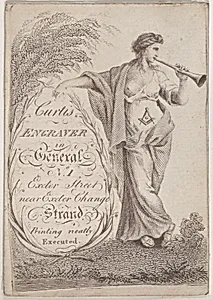
Trade Card for Curtis, Engraver
19th century
Medium
Engraving
Dimensions
Sheet: 3 3/4 × 2 5/8 in. (9.5 × 6.6 cm)
Classification
Prints|Ephemera
Department
Drawings and Prints
Museum
Metropolitan Museum of Art, New York, NY
Credit
Gift of Bella C. Landauer, 1926
Accession Number
26.28.321
Rights
Public Domain
Art Historical Context
Step into the world of 19th-century commerce with this charming *Trade Card for Curtis, Engraver*, anonymous engraving produced in the Victorian era. Measuring just 3 3/4 × 2 5/8 inches, this petite print served as a promotional tool for the engraver's services, blending artistry with everyday advertising. Trade cards like this were ubiquitous in Britain and America during the Industrial Revolution, distributed by businesses to showcase their work and attract customers—much like today's business cards, but often collected as souvenirs. Crafted via engraving, a meticulous intaglio technique where designs are incised into a metal plate and inked for transfer to paper, this card exemplifies the precision of 19th-century printmaking. Such ephemera highlights how commercial art democratized high-quality imagery, making intricate visuals accessible beyond fine art circles. Its classification in the Metropolitan Museum of Art's Drawings and Prints department underscores its value as a snapshot of graphic design history. Generously gifted to the Met in 1926 by collector Bella C. Landauer, this unassuming piece invites us to appreciate the unsung role of engravers in fueling Victorian innovation and consumer culture. A delightful reminder that even the smallest prints can pack a punch!