
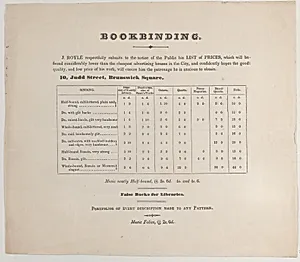
Trade card for J. Royle, bookbinder
19th century
Medium
Commercial Lithograph
Dimensions
Sheet: 7 13/16 × 8 7/8 in. (19.9 × 22.6 cm)
Classification
Prints|Ephemera
Department
Drawings and Prints
Museum
Metropolitan Museum of Art, New York, NY
Credit
Gift of Bella C. Landauer, 1926
Accession Number
26.28.170
Rights
Public Domain
Art Historical Context
Step into the vibrant world of 19th-century British commerce with this charming trade card for J.le, a skilled bookbinder. Produced anonymously a British artist, this modest yet eye-catching piece exemplifies the ephemera that littered parlors and shop counters during the Victorian era. Trade cards like this one served as portable advertisements, handed out to potential customers to promote services in an age when personalized marketing was revolutionizing business. Crafted as a commercial lithograph—a printing technique invented in the late 18th century that allowed for affordable, colorful mass production—this card measures a handy 7 13/16 × 8 7/8 inches, perfect for slipping into a pocket or pasting into a scrapbook. Lithography's precision enabled intricate designs and vivid hues, making even everyday promotions artistic gems. Bookbinding, central to the era's booming print culture, highlighted the craftsmanship behind leather-bound tomes and gilded spines, reflecting the intersection of trade and artistry. Today, preserved in the Metropolitan Museum of Art's Drawings and Prints department through the generous gift of Bella C. Landauer in 1926, this card offers a delightful glimpse into how ordinary tradespeople branded themselves amid industrialization. It's a reminder that ephemera, often discarded, holds cultural treasures about daily life and innovation.