
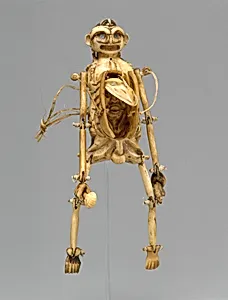
Transformation Puppet
Unknown Artist
late 18th–early 19th century
Medium
Bone, sinew, shell inlay, plant fiber
Dimensions
H. 6 1/2 in. (16.5 cm)
Classification
Bone/Ivory-Ornaments
Culture
Tlingit
Department
Arts of Africa, Oceania, and the Americas
Museum
Metropolitan Museum of Art, New York, NY
Credit
Ralph T. Coe Collection, Gift of Ralph T. Coe Foundation for the Arts, 2011
Accession Number
2011.154.34
Rights
Public Domain
Tags
Art Historical Context
This delicate *Transformation Puppet*, crafted by an unknown Tlingit artist the late 18th early 19th century exemplifies the masterful artistry of Northwest Coast Indigenous peoples from present-day Alaska. Standing just 6½ inches (16.5 cm) tall, it is fashioned from bone and sinew for articulated joints, adorned with shimmering shell inlay and plant fiber—materials sourced sustainably from the region's abundant natural environment. Classified as a bone ornament, its compact size suggests it was a portable ritual object, likely carried by shamans during ceremonies. The puppet's design captures the Tlingit fascination with transformation, a core theme in their cosmology. Tags highlighting skeletons and octopuses point to a shape-shifting figure, where a skeletal human form morphs into a powerful octopus spirit, symbolizing supernatural abilities, healing, and connections between the human and spirit worlds. Such motifs underscore the Tlingit's animistic beliefs, where shamans harnessed animal powers to navigate the spiritual realm. Housed in the Metropolitan Museum of Art's Arts of Africa, Oceania, and the Americas department (gift of the Ralph T. Coe Foundation, 2011), this rare survivor offers a window into pre-colonial Tlingit ingenuity. Its intricate carving and inlay techniques reveal sophisticated craftsmanship, blending functionality with profound cultural symbolism for a people whose art wove stories of resilience and the supernatural.