
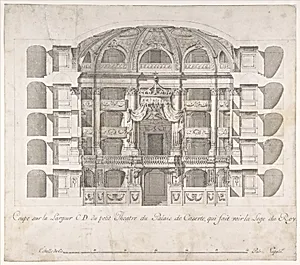
Transverse Section of the Small Theater in the Palace of Caserta with a View Towards the Royal Box
1700–1773
Medium
Pen and black-gray ink, brush and gray wash, over traces of compass and ruled construction lines in graphite
Dimensions
20-1/4 x 14-15/16 in. (51.4 x 37.9 cm)
Classification
Drawings
Department
Drawings and Prints
Museum
Metropolitan Museum of Art, New York, NY
Credit
The Elisha Whittelsey Collection, The Elisha Whittelsey Fund, 1964
Accession Number
64.669.2
Rights
Public Domain
Tags
Art Historical Context
Step into the grandeur of 18th-century Italy with Luigi Vanvitelli *Transverse Section of the Theater in the Palace oferta with a View Towards the Royal*. This meticulous architectural drawing, created by the renowned Neapolitan architect (1700–1773), a cross-sectional view of the intimate theater within the opulent Royal Palace of Cas—often hailed as the "Versailles of the South." Commissioned by the Bourbon kings, the palace symbolized enlightened absolutism, blending Baroque splendor with emerging Neoclassical restraint under Vanvitelli's masterful design. Vanvitelli's drawing reveals the theater's ingenious spatial drama, spotlighting the elevated Royal Box for the monarch's privileged gaze. Executed in pen and black-gray ink with brush and gray wash over graphite construction lines, it showcases precise compass and ruled techniques typical of the era's architectural planning. These methods allowed for exact proportions and shading that evoke depth and light, bridging blueprint and vision. Housed in the Metropolitan Museum of Art's Drawings and Prints department, this 20¼ x 14⅞-inch work (The Elisha Whittelsey Collection, 1964) offers a rare glimpse into royal spectacle and architectural innovation, inviting us to imagine the echo of applause beneath Caserta's gilded ceilings.
About the Artist
Luigi Vanvitelli · 1700–1773
Born 12 May 1700; died 1 March 1773. Famous for his design for the Royal Palace at Caserta, built 1751. Vanvitelli was active in Rome, Naples and nearby towns, also Brescia, Milan and Genoa. Comment on works: Portraits