
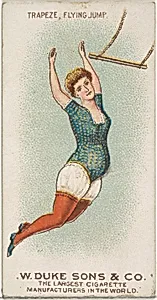
Trapeze, Flying Jump, from the Gymnastic Exercises series (N77) for Duke brand cigarettes
Medium
Commercial color lithograph
Dimensions
Sheet: 2 3/4 x 1 1/2 in. (7 x 3.8 cm)
Classification
Prints|Ephemera
Department
Drawings and Prints
Museum
Metropolitan Museum of Art, New York, NY
Credit
The Jefferson R. Burdick Collection, Gift of Jefferson R. Burdick
Accession Number
63.350.204.77.51
Rights
Public Domain
Tags
Art Historical Context
Step into the vibrant world of 19th-century advertising with *Trapeze, Flying Jump a diminutive yet dynamic commercial color lithograph from W. Duke, Sons & Co.'s *Gymnastic Exercises* (N77), produced in 1887. Measuring just 2¾ x 1½ inches, this ephemera captures a daring female acrobat mid-leap on the trapeze, her form frozen in graceful motion against a simple backdrop. Part of Duke's innovative cigarette card inserts—tiny collectibles tucked into packs to boost brand loyalty—these prints celebrated athletic prowess at a time when women's physical feats were gaining visibility. Chromolithography, the medium here, was a breakthrough in affordable color printing, enabling mass production of eye-catching images that blurred the line between art and commerce. Duke, a tobacco giant, pioneered such series, turning everyday smokes into portals for education and entertainment on themes like gymnastics. This card reflects the era's growing fascination with women's athletics, from circuses to emerging sports, challenging Victorian norms of femininity. Housed in the Metropolitan Museum of Art's Jefferson R. Burdick Collection, *Trapeze, Flying Jump* reminds us how ephemera preserves cultural snapshots—ephemeral promotions that endure as artifacts of innovation, empowerment, and the thrill of flight. (198 words)
About the Artist
W. Duke, Sons & Co. · 1870–1920
**W. Duke, Sons & Co.: Pioneers of Chromolithographic Trade Card Art** W. Duke, Sons & Co., an American tobacco manufacturer, emerged from the entrepreneurial vision of Washington Duke (1820–1905) and his sons in Durham, North Carolina. After the Civil War, Washington abandoned farming in 1874 to join his eldest son, Brodie L. Duke, in the burgeoning tobacco trade, establishing a factory that for...