
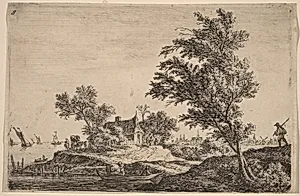
Traveler Passing Two Large Trees
1601 to 1650
Medium
etching
Classification
Department
CG-E
Museum
National Gallery of Art, Washington, D.C.
Credit
Rosenwald Collection
Accession Number
1946.11.216
Rights
Public Domain
Art Historical Context
**Traveler Passing Two Large Trees** is a delicate etching by Anthonie Waterloo, a Dutch artist active during the early to mid-17th centuryca. 1601–1650). Part of the National Gallery of Art's Rosen Collection in the Prints department (CG-E), this work the Dutch Golden Age's fascination with nature and the humble wanderer. Waterloo, often called the "Dutch Claude Lorrain" for his poetic landscapes, captures a solitary traveler moving past two majestic trees, evoking a sense of quiet journey through the countryside. Etching, Waterloo's preferred medium, allowed for intricate line work on copper plates, bitten by acid to create rich textures and depth. This technique was revolutionary in the 1600s, enabling artists to produce detailed, reproducible images that brought the beauty of the Dutch landscape to collectors across Europe. His precise, atmospheric style—marked by layered foliage, winding paths, and subtle light—reflects influences from Rembrandt and the emerging realism of the era. This print not only showcases Waterloo's mastery of printmaking but also highlights 17th-century cultural reverence for travel and the sublime in nature. A serene invitation to pause and ponder, it's a gem for visitors appreciating the artistry of everyday wonder. (198 words)
About the Artist
Anthonie Waterloo · 1609–1690
Anthonie Waterloo (1609–1690) was a prominent Dutch Golden Age landscape artist, born on May 6 in Lille, then part of the Spanish Netherlands. Little is known of his early life beyond his mother, Magdalena Vaillant, who joined Amsterdam's Walloon Church in 1621, with Waterloo following in 1630; no records exist of formal training, and he was likely self-taught. Registered as a painter in Amsterdam...