
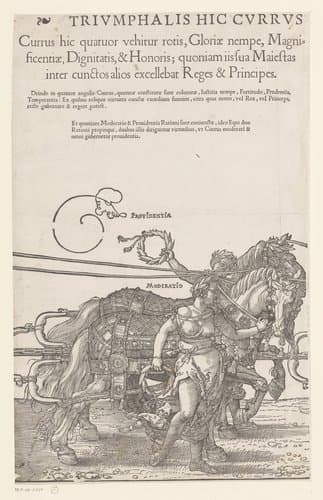
Triomfwagen van keizer Maximiliaan I
1545
Medium
letterpress printing
Dimensions
248; 392
Rights
Public Domain
About this artwork
houtsnede en boekdruk
Art Historical Context
This striking woodcut and letter print, created by Nuremberg Hans Guldenmund in 1545, depicts the triumphal chariot of Holy Roman Emperor Maximilian. Measuring roughly 39 by 25 centimeters, the work captures the grandeur of an imperial procession, a theme that celebrated military victories and dynastic power in Renaissance Europe. Produced more than two decades after Maximilian’s, it reflects the emperor’s lasting legacy and the continued fascination with his carefully crafted public image. Maximilian I actively commissioned elaborate printed processions, most famously involving artists like Albrecht Dürer, to project imperial authority across his vast territories. Guldenmund’s version, combining bold woodcut imagery with movable type, exemplifies how printmaking allowed such spectacles to reach wide audiences affordably. The technique—carving designs into wood blocks and integrating them with letterpress text—marked a pivotal shift in the 16th century, transforming art from unique objects into reproducible cultural statements. Today, the print offers visitors insight into both political propaganda and technological innovation. Its survival highlights the enduring appeal of Renaissance triumphal imagery and the vital role of print culture in shaping historical memory.
About the Artist
Hans Guldenmund · 1450–1560
Hans Guldenmund (ca. 1450–1560) was a prolific Nuremberg printer, publisher, illuminator, and graphic artist whose woodcut broadsheets captured the turbulent religious, political, and military events of the early Reformation era. Active in the thriving print culture of Nuremberg, a hub for publishing since the late 15th century, Guldenmund operated his workshop near the meat markets ("bei den Flei...