
Triomfwagen van keizer Maximiliaan I
1609
Medium
letterpress printing
Dimensions
364; 494
Rights
Public Domain
About this artwork
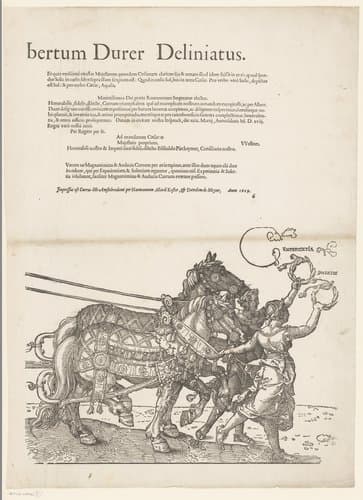
De grote triomfwagen ter ere van keizer Maximiliaan I bij zijn overlijden op 12 januari 1519. Achtste blad met het zesde span paarden met Experientia en Solertia.
Art Historical Context
Behold the *Triomfwagen van ke Maximiliaan I*Triumphal Chariot Emperor Maximilian I), striking letterpress print created by Hans Guldenmund 1609. Measuring 494 mm high by 364 mm wide, this forms part of a grand commemorative series honoring the Roman Emperor Maximilian I (1459–1519), who passed away on January 12 1519. Maximilian was a visionary patron of the arts, famous for commissioning elaborate posthumous monuments like his Triumphal Procession—a massive woodcut frieze depicting his imagined funeral cortege. Guldenmund's print revives this spectacle nearly a century later, capturing the opulent imagery of a massive triumphal chariot drawn by teams of horses. This eighth sheet focuses on the sixth span of horses, guided by the allegorical figures *Experientia* (Experience) and *Solertia* (Skillfulness or Diligence). Such personifications underscore Renaissance ideals of wisdom and mastery, blending classical triumph with Habsburg grandeur. Produced via letterpress printing—a pivotal technique for mass-producing detailed images—this sheet highlights the era's printing innovations, allowing intricate designs to reach wide audiences beyond elite courts. Culturally, it reflects enduring reverence for Maximilian's legacy in the early 17th century, bridging medieval pageantry and Baroque splendor. Visitors, imagine parading through Antwerp's streets amid such a chariot— a vivid window into imperial pomp and the power of print to immortalize history.
About the Artist
Hans Guldenmund · 1450–1560
Hans Guldenmund (ca. 1450–1560) was a prolific Nuremberg printer, publisher, illuminator, and graphic artist whose woodcut broadsheets captured the turbulent religious, political, and military events of the early Reformation era. Active in the thriving print culture of Nuremberg, a hub for publishing since the late 15th century, Guldenmund operated his workshop near the meat markets ("bei den Flei...