
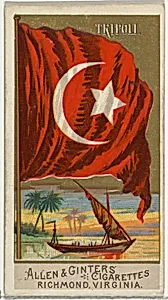
Tripoli, from Flags of All Nations, Series 2 (N10) for Allen & Ginter Cigarettes Brands
1890
Medium
Commercial color lithograph
Dimensions
Sheet: 2 3/4 x 1 1/2 in. (7 x 3.8 cm)
Classification
Prints|Ephemera
Department
Drawings and Prints
Museum
Metropolitan Museum of Art, New York, NY
Credit
The Jefferson R. Burdick Collection, Gift of Jefferson R. Burdick
Accession Number
63.350.201.10.44
Rights
Public Domain
Tags
Art Historical Context
Step into the vibrant world of late 19th-century American advertising with *Tripoli, from Flags of Nations, Series 2N10)*, issued by the pioneering tobacco firm Allen & G in 1890. These tiny chromolithographs were tucked into cigarette packs as collectible inserts, sparking a craze among smokers and sparking global curiosity. Allen & Ginter, founded by tobacco magnates Lewis Ginter and John Allen, revolutionized marketing by blending education with promotion, producing series on everything from birds to world leaders. Crafted as a commercial color lithograph, this pocket-sized gem (just 2¾ x 1½ inches) showcases the flag of Tripoli—likely the Ottoman Regency of Tripolitania—with bold, vivid hues achieved through chromolithography, a technique that layered colors via multiple lithographic stones for mass production. Its ephemeral nature belies its artistic flair, capturing national symbols in intricate detail despite the modest scale. Housed in the Metropolitan Museum of Art's Jefferson R. Burdick Collection, this print reflects an era of expanding empires and international fascination, where everyday items like cigarette cards fostered armchair exploration. A testament to Gilded Age commerce and collecting, it invites us to ponder how flags flew as emblems of distant lands right into American pockets.
About the Artist
Allen & Ginter
Allen & Ginter, the pioneering American tobacco firm based in Richmond, Virginia, emerged around 1880 from the partnership of John F. Allen and Lewis Ginter, evolving from Allen's earlier John F. Allen & Company. Allen retired in 1882, succeeded by John Pope, yet the brand endured under Ginter's leadership, employing over 1,100 workers—mostly women—for hand-rolled cigarettes by 1886. Ginter, a Dut...