
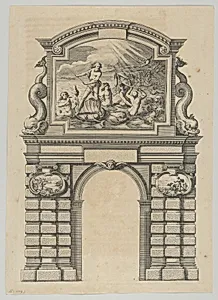
Triumphal arch, from 'Éloges et discours sur la triomphante réception du Roy en sa ville de Paris ...' by Jean-Baptiste de Machault
Medium
Etching
Dimensions
Sheet: 12 1/16 × 8 3/4 in. (30.7 × 22.2 cm) Plate: 11 9/16 × 7 15/16 in. (29.3 × 20.2 cm)
Classification
Prints|Prints-Fete|Ornament & Architecture
Department
Drawings and Prints
Museum
Metropolitan Museum of Art, New York, NY
Credit
The Elisha Whittelsey Collection, The Elisha Whittelsey Fund, 1960
Accession Number
60.619.6
Rights
Public Domain
Tags
Art Historical Context
This etching captures a magnificent triumphal arch erected for the celebratory entry of King Louis XIII into in 1629, as documented in Jean-Baptiste de Machault's publication *Éloges et discours la triomphante du Roy en sa ville Paris*. These temporary architectural spectacles were a hallmark of royal pageantry in early 17th-century France, blending classical Roman influences with Baroque exuberance to symbolize the monarch's power and divine favor. The arch, adorned with ornate decorations, served as a visual ode to the king's triumphs, immersing spectators in a spectacle of national pride. Crafted by a collaborative team—etcher Abraham Bosse, author Machault, and printers Pierre Firens I and Melchior Tavernier—the print exemplifies the era's mastery of etching. Bosse's precise lines render intricate architectural details with remarkable clarity, making complex ornamentation accessible through reproductive prints. Classified under prints of fêtes and architecture, this work from The Metropolitan Museum of Art's Elisha Whittelsey Collection highlights how such etchings preserved ephemeral events for posterity. Measuring about 12 by 9 inches, it invites us to envision the bustling streets alive with cheers, a reminder of how art immortalized monarchy's grandeur amid France's cultural flourishing under Richelieu's influence.
About the Artist
Abraham Bosse|Jean-Baptiste de Machault|Pierre Firens I|Melchior Tavernier · 1602–1676
Abraham Bosse (1604–1676) was a French printmaker and theorist whose approximately 1,600 etchings provide an unparalleled visual record of 17th-century French life. Born to Huguenot parents in Tours, he trained in Paris under Melchior Tavernier and became a devoted follower of Jacques Callot's technical innovations. Bosse's meticulous etchings depicted subjects ranging from daily life and fashion ...