
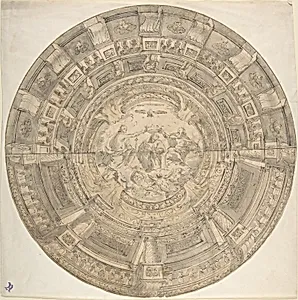
Trompe L'Oeil Ceiling with the Coronation of the Virgin and a Variant for the Decoration
17th century
Medium
Pen and black ink, brush and gray wash
Dimensions
11 5/8 in. (29.6 cm) (in diameter)
Classification
Drawings|Ornament & Architecture
Department
Drawings and Prints
Museum
Metropolitan Museum of Art, New York, NY
Credit
The Elisha Whittelsey Collection, The Elisha Whittelsey Fund, 1952
Accession Number
52.570.306
Rights
Public Domain
Tags
Art Historical Context
This exquisite 17th-century Italian, titled *Trompe L'Oeil Ceiling with the Coron of the Virgin and a for the Decoration*, captures the grandeur of Baroque ceiling designs. Created anonymously by an Italian artist using pen and black ink with brush and gray wash, preparatory sheet measures just 11 5/8 inches in diameter. It presents two variants of an illusory ceiling fresco, centering on the *Coronation of the Virgin—a triumphant scene linked to her Assumption into heaven, a popular motif in Catholic art during the Counter-Reformation. The trompe l'oeil technique, meaning "deceive the eye," is masterfully employed here to mimic architectural elements and sculptural depth on a flat surface. Through precise ink lines and subtle gray washes, the artist simulates vaulted spaces opening to divine visions, blurring the boundary between two and three dimensions. Such drawings were essential blueprints for grand church or palazzo decorations, showcasing Italy's innovative fusion of architecture, ornament, and religious narrative in the 17th century. Housed in the Metropolitan Museum of Art's Department of Drawings and Prints, thanks to The Elisha Whittelsey Collection, this work offers a window into the collaborative world of Baroque workshops. It highlights how anonymous draftsmen contributed to the era's opulent illusions, inspiring awe in viewers below.