
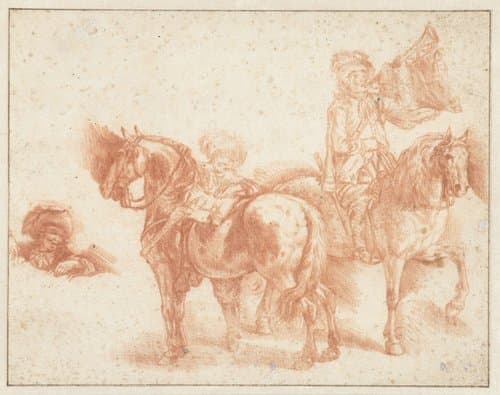
Trompetter te paard en een ruiter die zijn paard bestijgt, met een alternatieve studie voor zijn hoofd en schouders
after 1655
Medium
counterproof in red chalk; framing line in brown ink
Dimensions
205; 160
Rights
Public Domain
About this artwork
…; sale, H.J. Holgen et al. [unknown section.], Amsterdam (P. Brandt), 7 May 1951 sqq., no. 579, fl. 12.50, to the museum (L. 2228)
Art Historical Context
This delicate drawing, titled *Trompetter te paard en een ruiter die zijn paard bestijgt, met een alternatieve studie voor zijn hoofd en schouders* (Trumpeter on Horseback and a Rider Mounting His Horse, with an Alternative Study for His Head and Shoulders), captures dynamic equestrian scenes from after 1655. Created anonymously, it measures a modest 160 × 205 mm, inviting close inspection of its lively figures: a trumpeter astride his mount and another rider in mid-mount, accompanied by a variant sketch of the rider's head and shoulders. Such studies were common in the Dutch Golden Age, where artists honed compositions for paintings or prints, emphasizing movement and anatomy in everyday or ceremonial subjects like cavalry or parades. The medium—a counterproof in red chalk with a framing line in brown ink—reveals sophisticated workshop techniques. A counterproof is made by pressing damp paper against an original chalk drawing, producing a subtle mirror-image replica. This allowed artists to review their work reversed, refining balances and proportions without altering the primary sketch. Red chalk, prized for its warm tones and blendability, was a staple for figure studies in the 17th century, evoking the vitality of life drawing sessions. Acquired by the museum at a 1951 Amsterdam auction (P. Brandt, lot 579), this anonymous gem offers a glimpse into the iterative creative process of the era. Though its maker remains unknown, it embodies the meticulous draftsmanship that fueled Dutch art's golden legacy, delighting visitors with its intimate energy.
About the Artist
anonymous
In the vast tapestry of art history, "Anonymous" stands not as a singular individual but as a collective designation for countless unidentified creators whose works have endured across millennia. These artists, spanning prehistoric cave painters to medieval illuminators and folk craftsmen, produced the foundational layers of human visual culture. Prior to the Renaissance, when individual fame emer...