
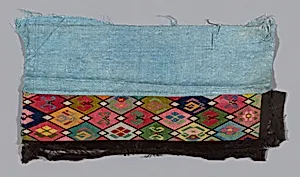
Trouser Band
Qing dynasty (1644–1911), 1875/1900
Medium
Forty-four pairs and eight odd pieces of embroidered sleeve, ankle bands, etc. on gauze.
Dimensions
18.5 × 33 cm (7 1/4 × 13 in.)
Classification
costume - embroidery
Department
Textiles
Museum
Art Institute of Chicago
Accession Number
238301
Rights
Public Domain
Art Historical Context
Nestled in the Art Institute of Chicago's Textiles collection, *Trouser Band* is a delicate Han-Chinese embroidery from China's Qing dynasty (1644–1911), dated around 1875–1900. This late imperial artifact comprises forty-four pairs and eight individual pieces of sleeve bands, ankle cuffs, and similar trims meticulously stitched onto fine gauze. Measuring just 18.5 × 33 cm, it exemplifies the exquisite craftsmanship of everyday costume accessories, likely used to secure or adorn trousers and sleeves in traditional Han attire. The medium—embroidery on translucent gauze—highlights advanced textile techniques of the era. Gauze, a lightweight silk weave, provided an ideal sheer base for vibrant threadwork, allowing intricate patterns to shine through. Such bands were essential for functionality and style, reflecting the Qing period's blend of practicality and aesthetic refinement amid social changes, including Western influences creeping into Chinese fashion. Culturally, these pieces offer a window into Han-Chinese daily life during the dynasty's waning years, showcasing the skill of anonymous female embroiderers who preserved motifs of nature, symbols, and geometry. As a preserved fragment of wearable art, *Trouser Band* underscores embroidery's role in personal expression and cultural continuity, inviting visitors to appreciate the quiet artistry woven into history.
About the Artist
Han-Chinese
**Han-Chinese** was the collective attribution given to anonymous artisans of Han Chinese descent who crafted intricate embroidered textiles during the Qing dynasty (1644–1911). These makers, active primarily in the late 18th to early 20th centuries, specialized in luxurious garments and furnishings that showcased the pinnacle of Han Chinese needlework traditions. Their early lives and individual ...