
Tuhfat al-Ahrar (The Gift to the Noble)
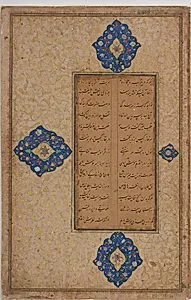
Medium
Ink, opaque watercolor, and gold on paper
Dimensions
H. 9 5/8 in. (24.4 cm) W. 6 1/4 in. (15.9 cm)
Classification
Codices
Department
Islamic Art
Museum
Metropolitan Museum of Art, New York, NY
Credit
Rogers Fund, 1946
Accession Number
46.178.2
Rights
Public Domain
Art Historical Context
Welcome to the enchanting world of Persian manuscript illumination at the Metropolitan Museum of Art. *Tuhfat al-Ahrar (The Gift to the Noble)*, created between 1485 and 1490, is a exquisite codex by the renowned scholar-poet Maulana Nur al-Din `Abd al-Rahman Jami (1414–1492). Jami, a master of Sufi mysticism and Persian literature, penned this mathnawi—a rhymed poetic narrative—as part of his profound explorations of spiritual devotion and moral wisdom, drawing from Islamic traditions to guide the soul toward enlightenment. Crafted with ink, opaque watercolor, and gold on paper (measuring 9⅝ × 6¼ inches), this manuscript exemplifies the pinnacle of Timurid-era book arts in 15th-century Persia. The opaque watercolors, a hallmark of Persian miniatures, create vibrant, jewel-like scenes, while gold accents illuminate margins and illustrations, symbolizing divine light. Such codices were prized treasures for elite patrons, blending calligraphy, poetry, and painting into a unified sacred object. Acquired through the Rogers Fund in 1946, *Tuhfat al-Ahrar* offers a window into the cultural flourishing of the Islamic world, where art and spirituality intertwined. Its delicate beauty invites visitors to ponder Jami's timeless message: true nobility lies in the heart's noble pursuits.
About the Artist
Maulana Nur al-Din `Abd al-Rahman Jami · 1414–1492
**Maulana Nur al-Din `Abd al-Rahman Jami** (1414–1492) stands as one of the towering figures of Persian literature and Sufi thought during the Timurid era. Born in Kharjerd near Jam in Khorasan (present-day Iran) to a Persian family, he later adopted “Jami” as his pen name. His father, Nizam al-Din Ahmad, a theologian, lawyer, and Sufi, served as his first teacher and mentor. The family soon moved...