
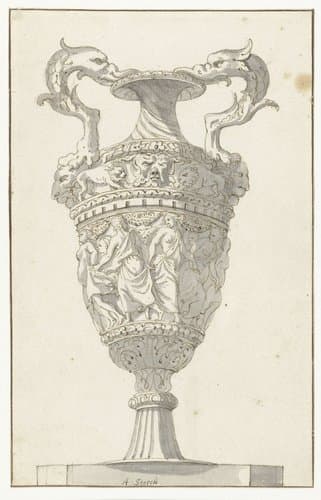
Tuinvaas met een fries van dansende vrouwen
1645 - 1710
Medium
pen
Dimensions
183; 116
Rights
Public Domain
About this artwork
hoogte 183 mm x breedte 116 mm
Art Historical Context
Abraham Storck's *Tuinvaas met een fries van dansende vrouwen (Garden Vase with Frieze of Dancing Women is a delicate pen drawing from the Dutch Golden Age, capturing the artist's flair for ornate, classical-inspired designs. Created during Storck's active years (roughly 1645–1710), this compact work measures just 183 mm high by 116 mm wide, showcasing his precise draftsmanship on a intimate scale. The title evokes a garden vase adorned with a lively frieze of dancing figures, blending everyday decorative arts with mythological revelry—a nod to antiquity's enduring influence on 17th-century European aesthetics. Storck, a prominent Amsterdam painter known for Italianate landscapes and capriccios, often drew from classical motifs, reflecting the era's fascination with ancient Rome and Greece amid the prosperity of the Dutch Republic. This piece exemplifies his skill in pen work, a technique favored for its linear clarity and ability to convey texture and movement without color. Such drawings served as studies for paintings, prints, or even ceramics, highlighting the interconnected worlds of fine art and craft. For visitors, this artwork offers a window into Baroque-era whimsy: imagine elegant women twirling in eternal dance on a vase destined for a grand estate garden. Its small size belies its cultural charm, reminding us how Storck infused everyday objects with timeless vitality.